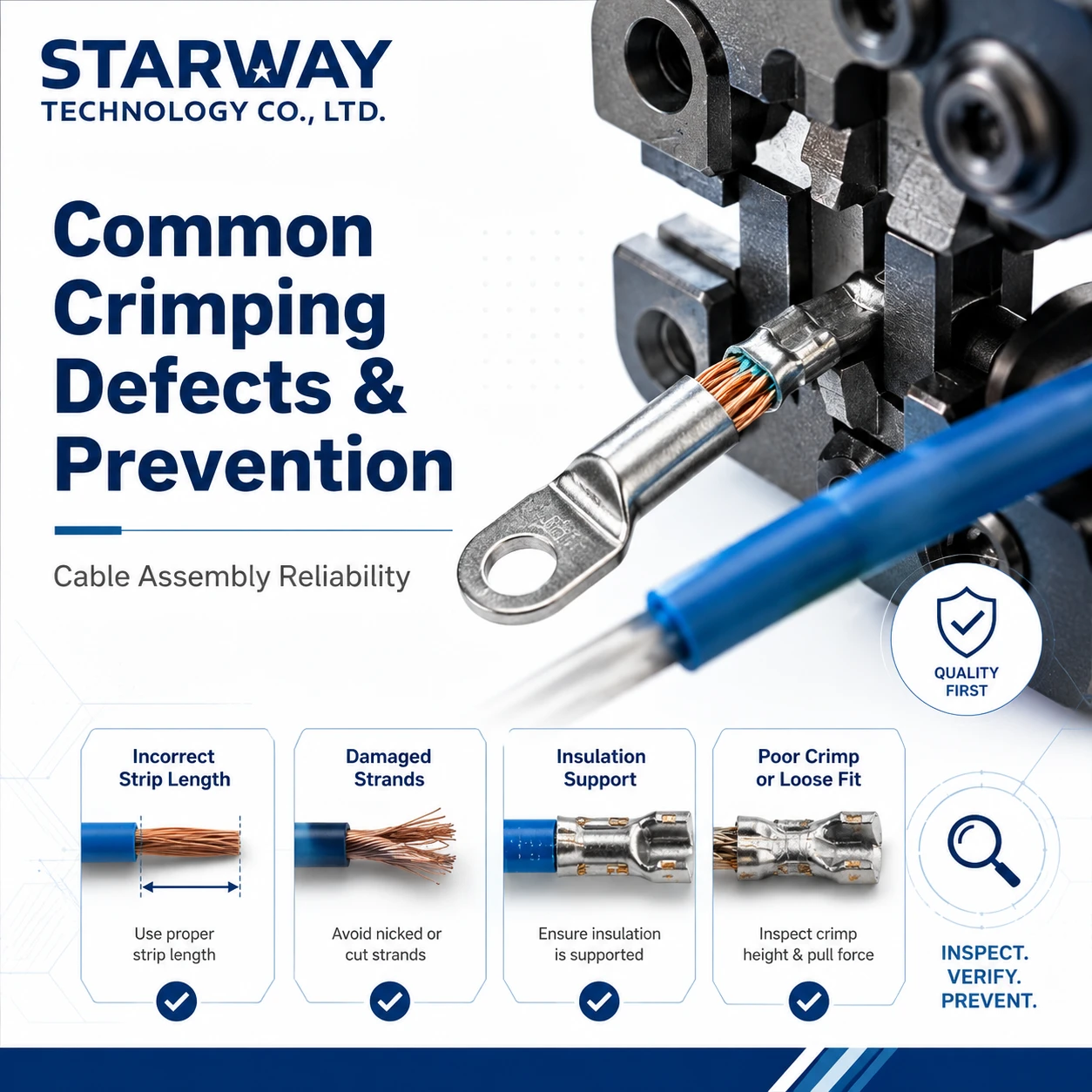
Common Crimping Defects in Cable Assembly and How to Prevent Them
Crimping defects can hidden reliability risks in cable assembly manufacturing. Starway Technology explains how to prevent poor wire stripping, incorrect strip length, damaged strands, wrong terminal-tool-wire matching, weak insulation support, poor crimp inspection, leak paths, environmental sealing failures, and insufficient testing through IPC-based workmanship and Taiwan-based custom wire harness OEM production.
Common Crimping Defects in Cable Assembly and How to Prevent Them explains how small defects in wire preparation, terminal crimping, insulation support, connector sealing, and final testing can become major field reliability problems. In a cable assembly, a crimp is not only a mechanical joint; it is the controlled electrical and mechanical interface between the conductor, terminal, connector, insulation, and operating environment.
Starway Technology Co., Ltd. is a professional custom wire harness and cable assembly OEM manufacturer based in Taiwan. We support customer drawings, BOMs, samples, high-mix low-volume production, terminal crimping, connector assembly, continuity testing, insulation resistance testing, and project-based manufacturing for industrial, aerospace, military, communication, and high-reliability applications.
Certificate and Standard Reference
This article can display Starway Technology's IPC membership and IPC-related certificate references to support customer confidence in our crimping workmanship, defect-prevention thinking, and process-oriented manufacturing approach.
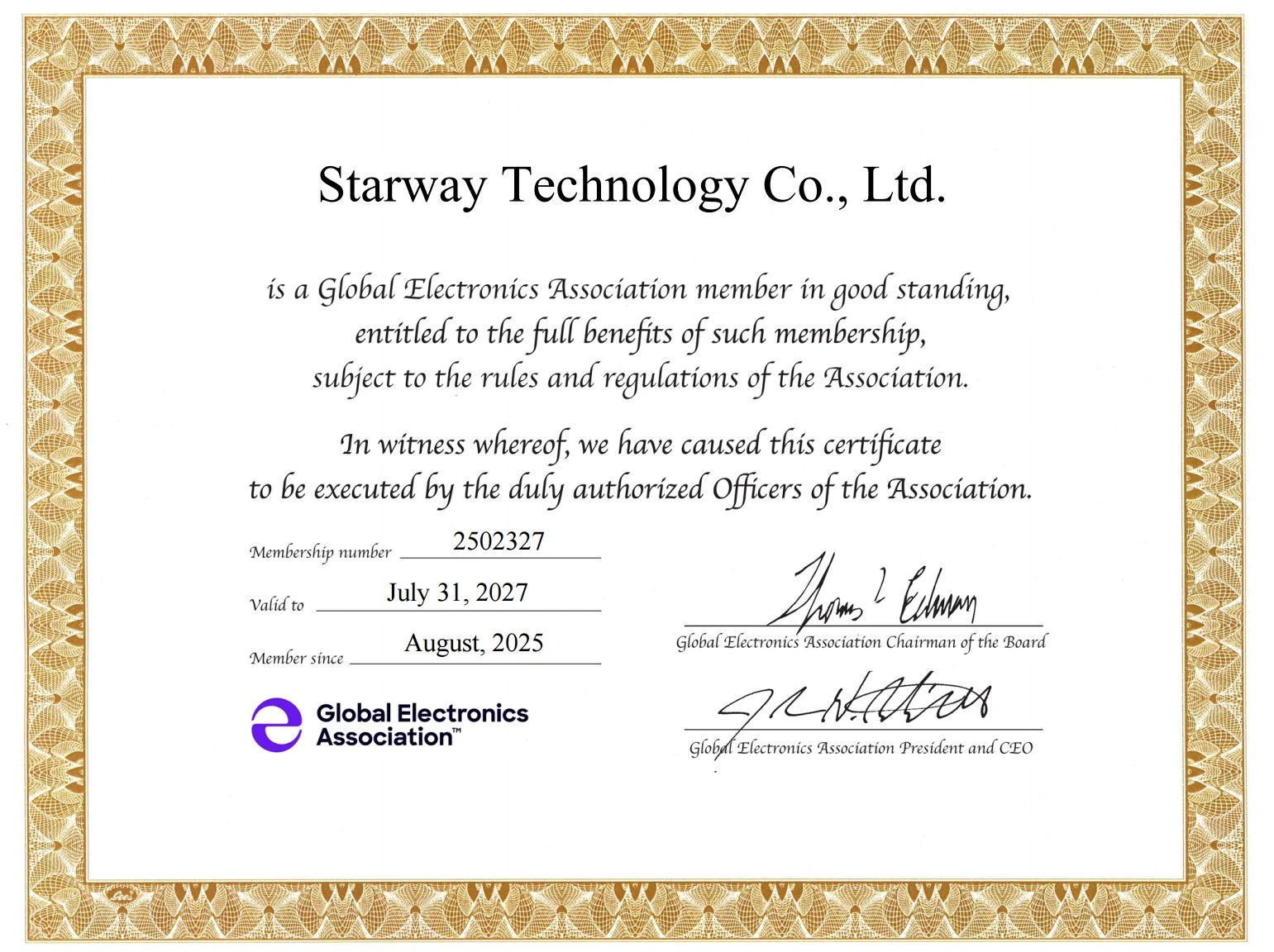
IPC Member
Starway Technology is listed in the official Global Electronics Association / IPC member directory as an OEM company, supporting our professional positioning in custom wire harness manufacturing.
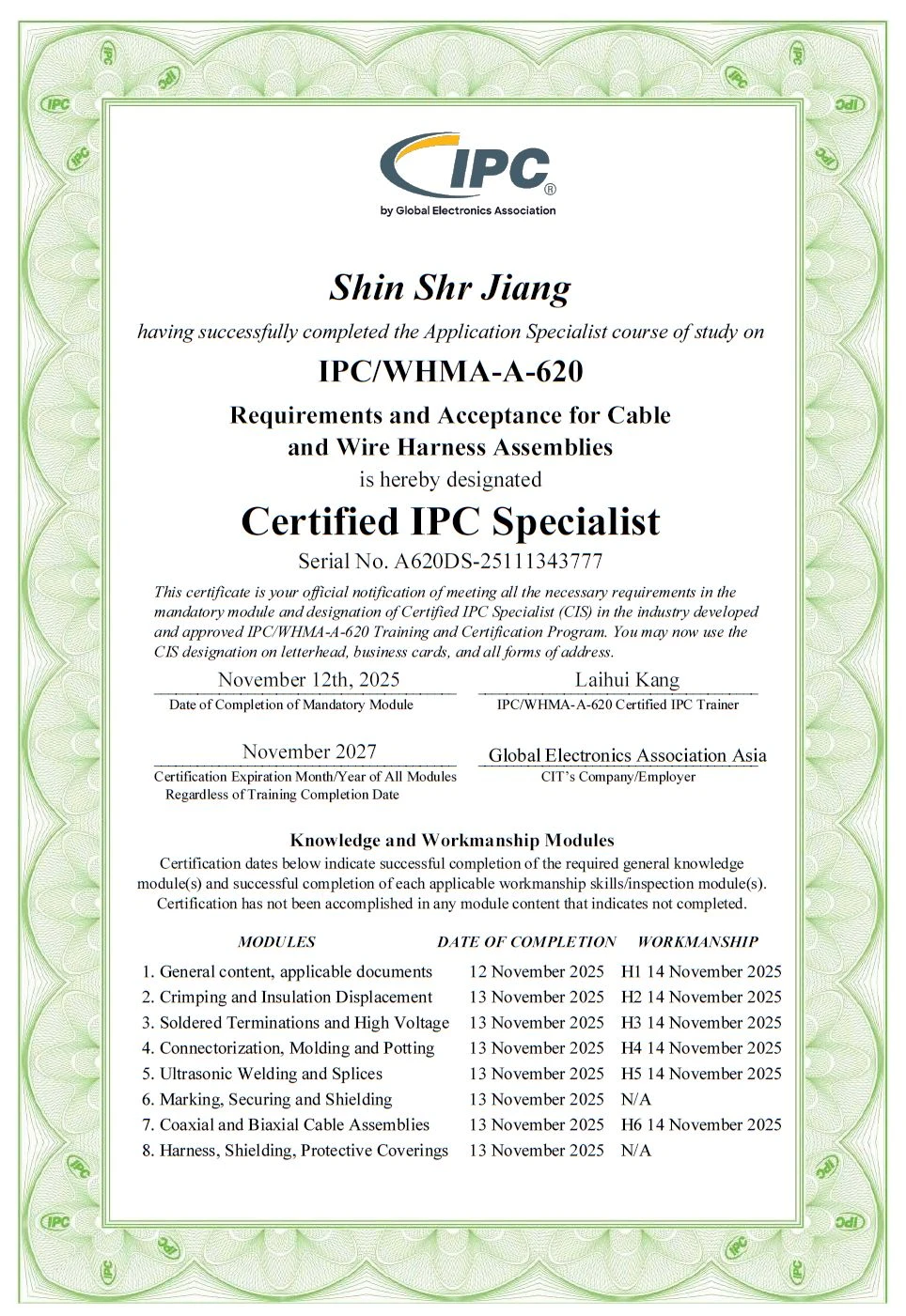
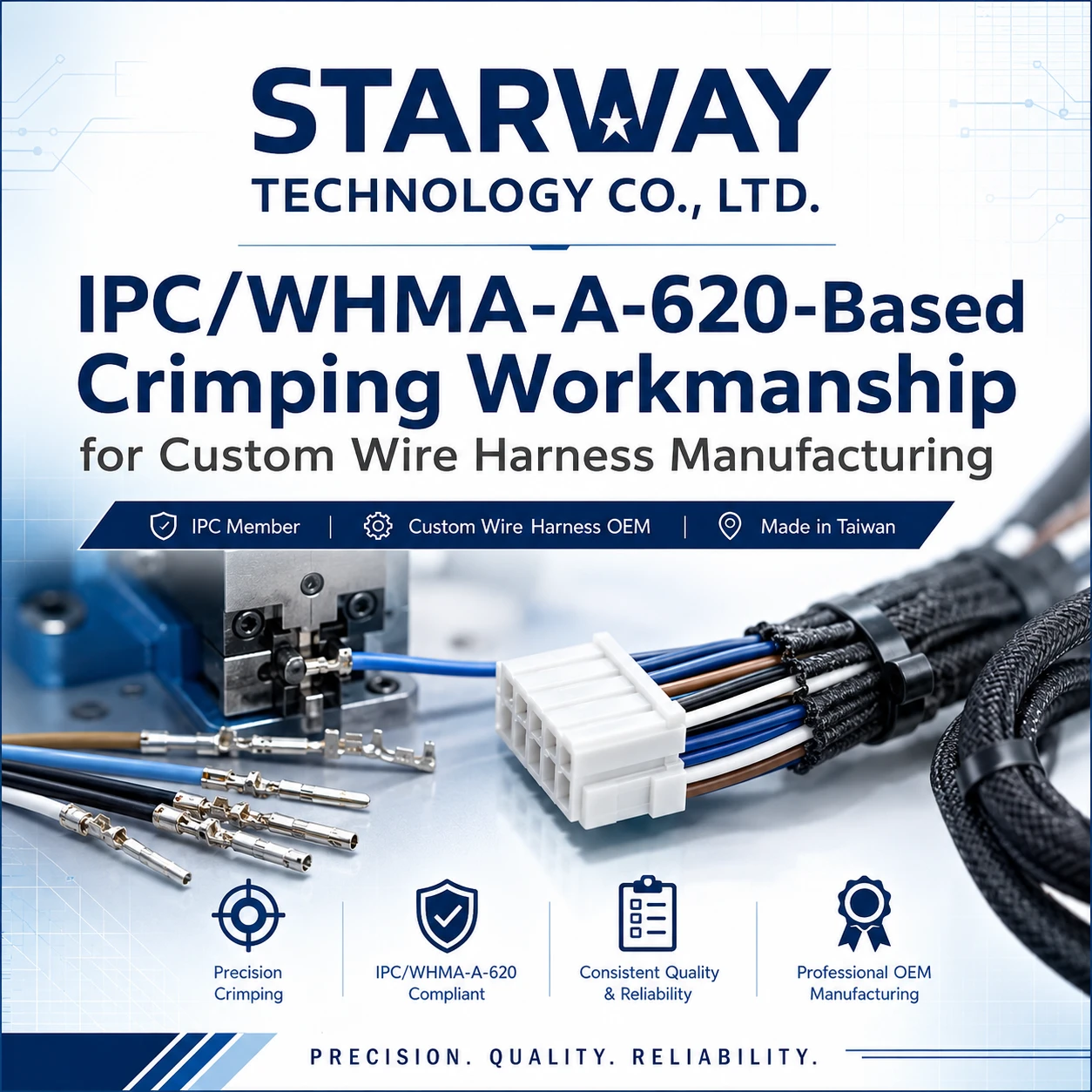
IPC/WHMA-A-620
IPC/WHMA-A-620 is an important workmanship reference for wire preparation, stripping, crimp terminals, connector assembly, shielding, protective coverings, and testing.
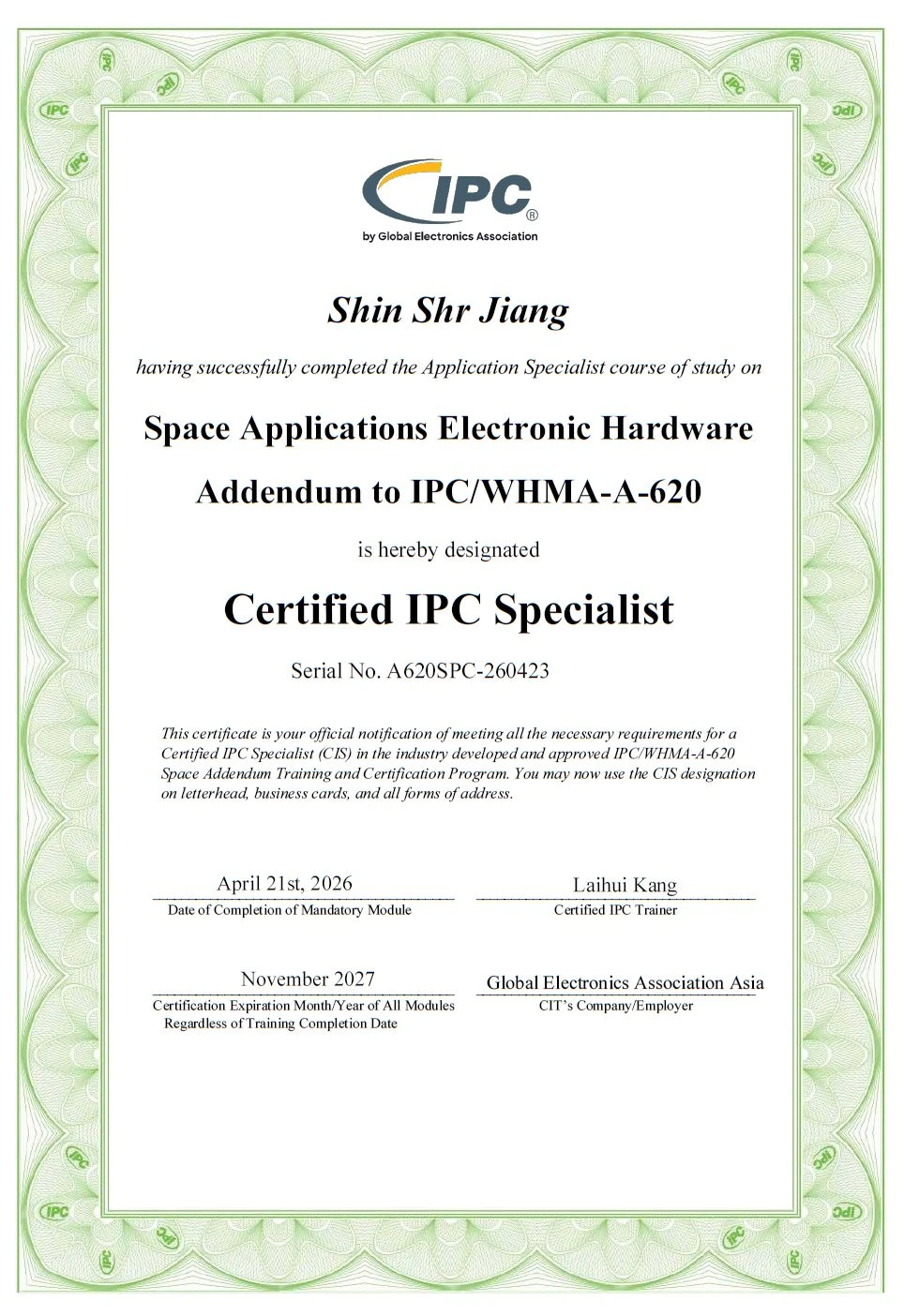
IPC/WHMA-A-620E-S
IPC/WHMA-A-620E-S is a space and military applications addendum used with IPC/WHMA-A-620E for higher-reliability cable and wire harness applications.
Technical Reference Links
Starway Technology applies crimping defect-prevention and environmental sealing process-control principles aligned with the technical guidance published by leading interconnect manufacturers such as TE Connectivity and Glenair. These public references show that reliable cable assembly depends on correct cable, terminal, tooling, wire preparation, trained operation, crimp inspection, sealing design, material selection, and final verification.
This article does not claim that Starway Technology is TE Connectivity or Glenair, nor does it imply formal approval by these manufacturers. Instead, it shows that Starway uses a similar engineering language and process-control mindset when supporting custom wire harness and cable assembly projects.
- TE Connectivity Crimping Guide Reference
- TE Connectivity Guide to Crimping emphasizes correct tooling, correct terminals, proper wire preparation, trained operators, strip length control, wire placement, insulation support crimp adjustment, crimp inspection, and die inspection.
- Glenair Environmental Interconnect Reference
- Glenair Stopping Leaks Before They Happen highlights environmental sealing, grommet seals, O-rings, sealing plugs, shrink boots, backshells, overmolding, material compatibility, and leak path prevention in harsh-environment interconnect systems.
Technical Summary
A crimping defect is any condition that prevents the terminal, conductor, insulation, connector, or sealing structure from achieving the intended electrical, mechanical, or environmental performance. Some defects are visible, such as damaged strands, incorrect conductor position, missing bellmouth, or poor insulation support. Others are hidden and may only appear later as high resistance, intermittent contact, weak pull strength, leakage, corrosion, moisture ingress, or field failure.
Reliable defect prevention requires process control before, during, and after crimping: correct wire and terminal selection, proper tooling, clean wire stripping, correct strip length, correct wire placement, crimp height verification, visual inspection, pull force testing when required, connector insertion check, environmental sealing review, continuity testing, insulation resistance testing, and final packaging protection.
Why Crimping Defects Matter
A poor crimp can pass a simple visual check or even a basic continuity test, but still fail later under vibration, bending, thermal cycling, high current, moisture, or repeated handling. This is why crimping quality must be managed as a complete manufacturing process, not only as an operator skill.
Electrical Reliability
Defects such as insufficient compression, damaged strands, or poor contact area can increase resistance, cause intermittent signals, or localized heating.
Mechanical Strength
Weak insulation support, poor conductor crimping, or incorrect tooling may reduce pull strength and make the assembly vulnerable to vibration or handling stress.
Environmental Protection
Poor sealing, missing plugs, damaged grommets, or weak shrink boot bonding may leak paths that allow moisture, chemicals, or corrosion to damage the interconnect system.
Common Crimping Defects and Prevention Methods
The following defects are commonly associated with poor wire preparation, incorrect terminal-tool-wire matching, weak inspection control, or insufficient process discipline.
- 1. Nicked or Broken Wire Strands
- Risk: Reduced conductor cross-section, lower pull strength, increased resistance, and possible fatigue failure. Prevention: Use correct stripping tools, control blade setting, verify conductor condition, and reject damaged strands.
- 2. Incorrect Strip Length
- Risk: Conductor may not seat correctly, insulation may enter the wire barrel, or conductor brush may be too short or too long. Prevention: Define strip length by terminal specification and inspect wire placement before production.
- 3. Insulation Crimp Too Loose
- Risk: No effective strain relief, allowing wire movement and stress transfer to the conductor crimp. Prevention: Adjust insulation crimp setting and confirm that insulation is firmly supported.
- 4. Insulation Crimp Too Tight
- Risk: Crushed insulation, damaged strands, broken conductor, or reduced flex life. Prevention: Match insulation barrel range to wire insulation outer diameter and verify cross-section or visual condition when required.
- 5. Wrong Terminal, Wire, or Tool Combination
- Risk: Poor crimp profile, unstable mechanical retention, wrong crimp height, or defective termination. Prevention: Verify terminal part number, wire gauge, insulation diameter, applicator, tooling, die set, and approved work instruction.
- 6. Missing or Incorrect Bellmouth
- Risk: Sharp barrel edge may cut conductor strands and reduce long-term reliability. Prevention: Check terminal position, tooling alignment, and crimp location before batch production.
- 7. Poor Conductor Brush Position
- Risk: Too little conductor exposure may indicate incomplete insertion; too much may interfere with terminal function or connector assembly. Prevention: Control strip length and wire stop position.
- 8. Poor Environmental Sealing
- Risk: Moisture, fuel, oil, dust, or chemical ingress may corrosion, leakage, insulation failure, or system shutdown. Prevention: Use proper grommet fit, sealing plugs, shrink boots, backshells, overmolding, potting, and material compatibility review.
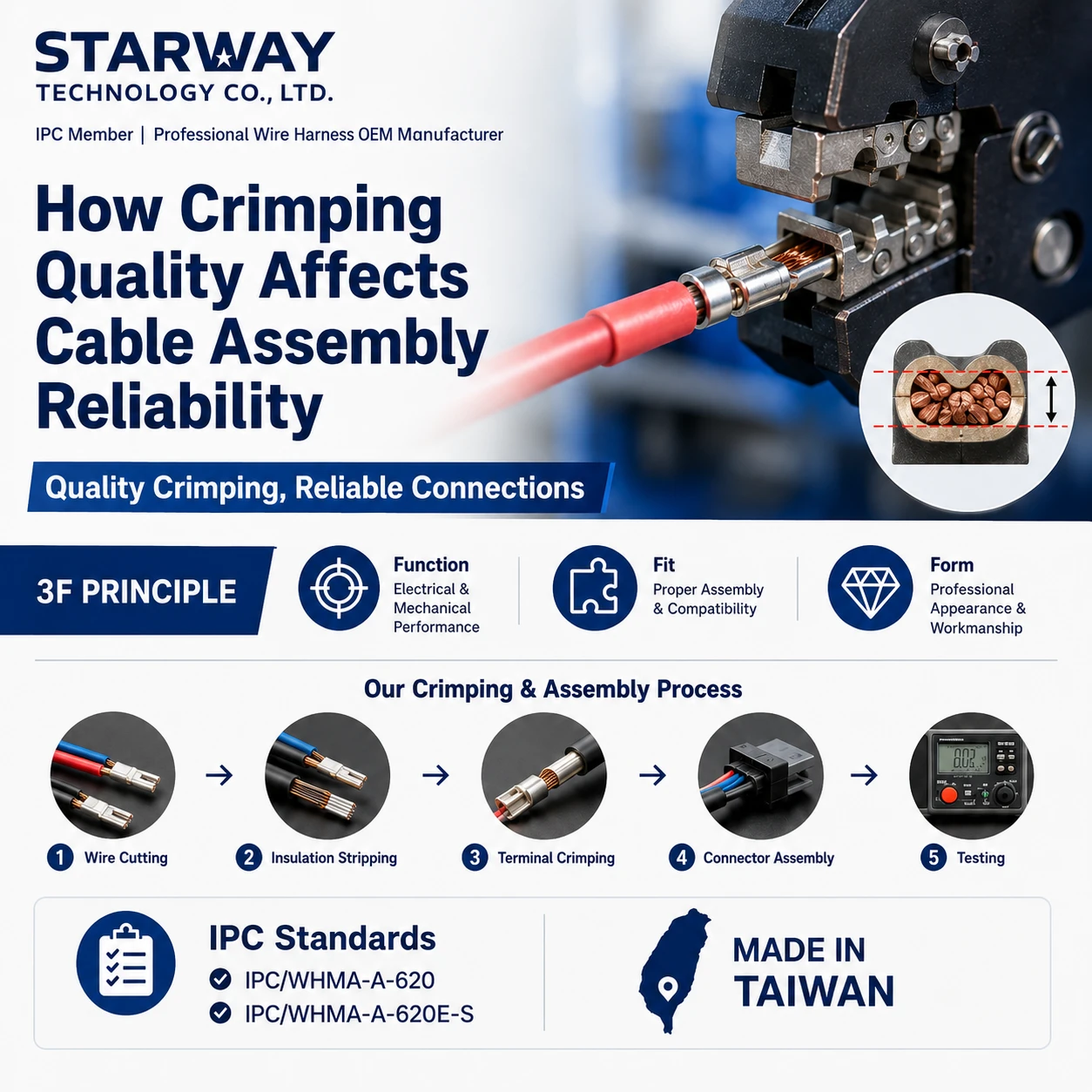
IPC Core Principle: Function, Fit, and Form
IPC workmanship thinking is closely connected with the practical quality concept of Function, Fit, and Form. Some customers may also describe the third principle as Formal / Appearance. For crimping defect prevention, these three principles help evaluate whether the finished cable assembly works electrically, fits mechanically, and maintains acceptable workmanship appearance.
Crimping Defect Prevention Process Flow
Starway Technology controls crimping defect prevention as a complete process flow, from drawing review to final testing and packaging.
Drawing and BOM Review
Customer drawings, wire size, terminal part number, connector part number, sealing requirement, test requirement, and acceptance criteria are reviewed.
Project PreparationMaterial Verification
Wire, terminal, connector, grommet, sealing plug, heat shrink, backshell, sleeve, and accessories are checked against the approved BOM.
Material ControlWire Cutting and Stripping
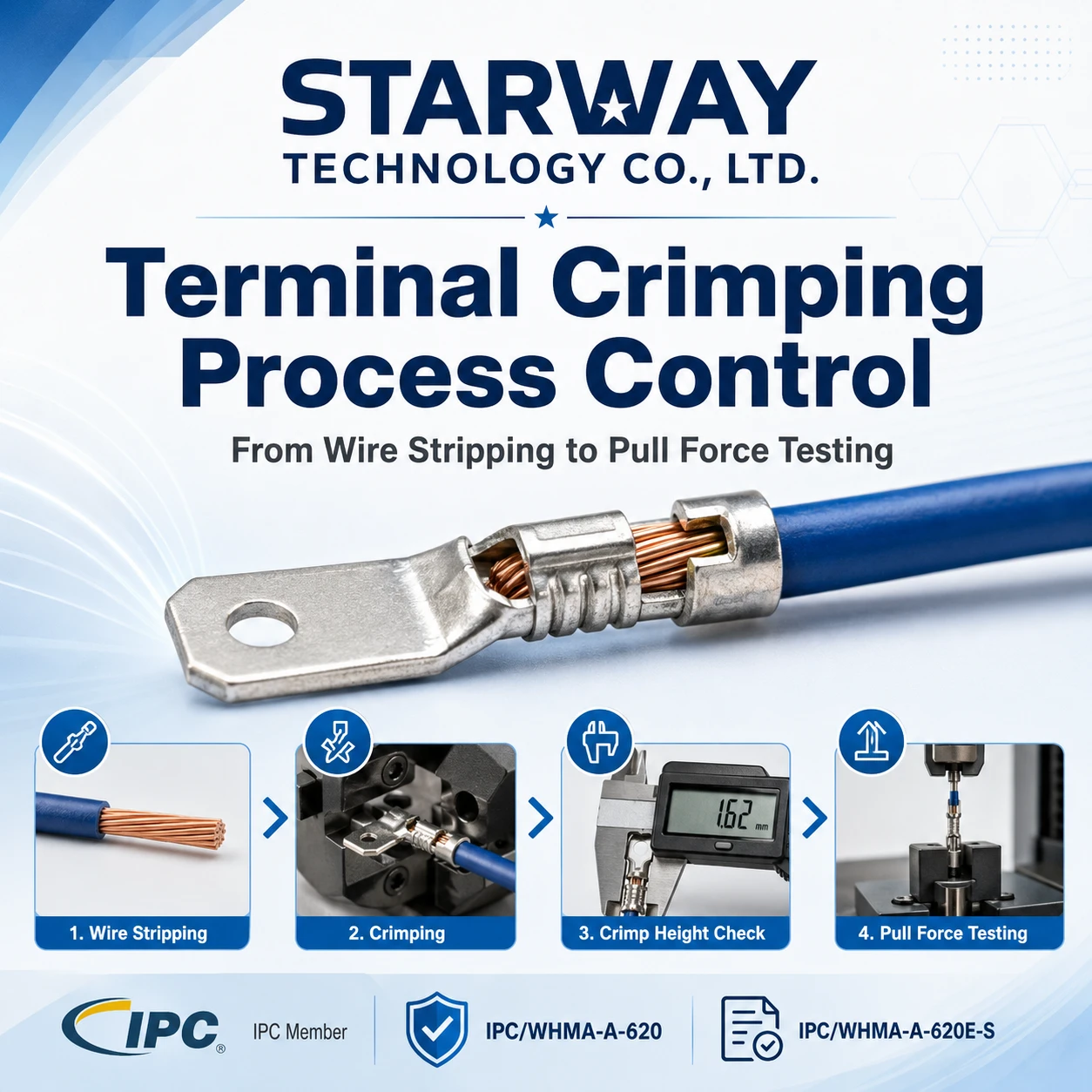
Wires are cut and stripped while checking length, strip length, conductor exposure, insulation edge, nicked strands, and broken strands.
Wire PreparationTooling Setup
Crimp tool, applicator, die set, locator, insulation crimp setting, wire stop, and production setup are confirmed before batch production.
Tooling ControlTerminal Crimping
Terminals are crimped with attention to conductor placement, wire barrel compression, insulation support, bellmouth, and terminal shape.
Crimping ControlCrimp Inspection
Crimp height, conductor brush, bellmouth, insulation support, terminal deformation, cut-off condition, and visual workmanship are reviewed.
In-Process InspectionPull Force Testing
Pull force testing may be performed when required to confirm mechanical retention and detect hidden wire preparation or crimping issues.
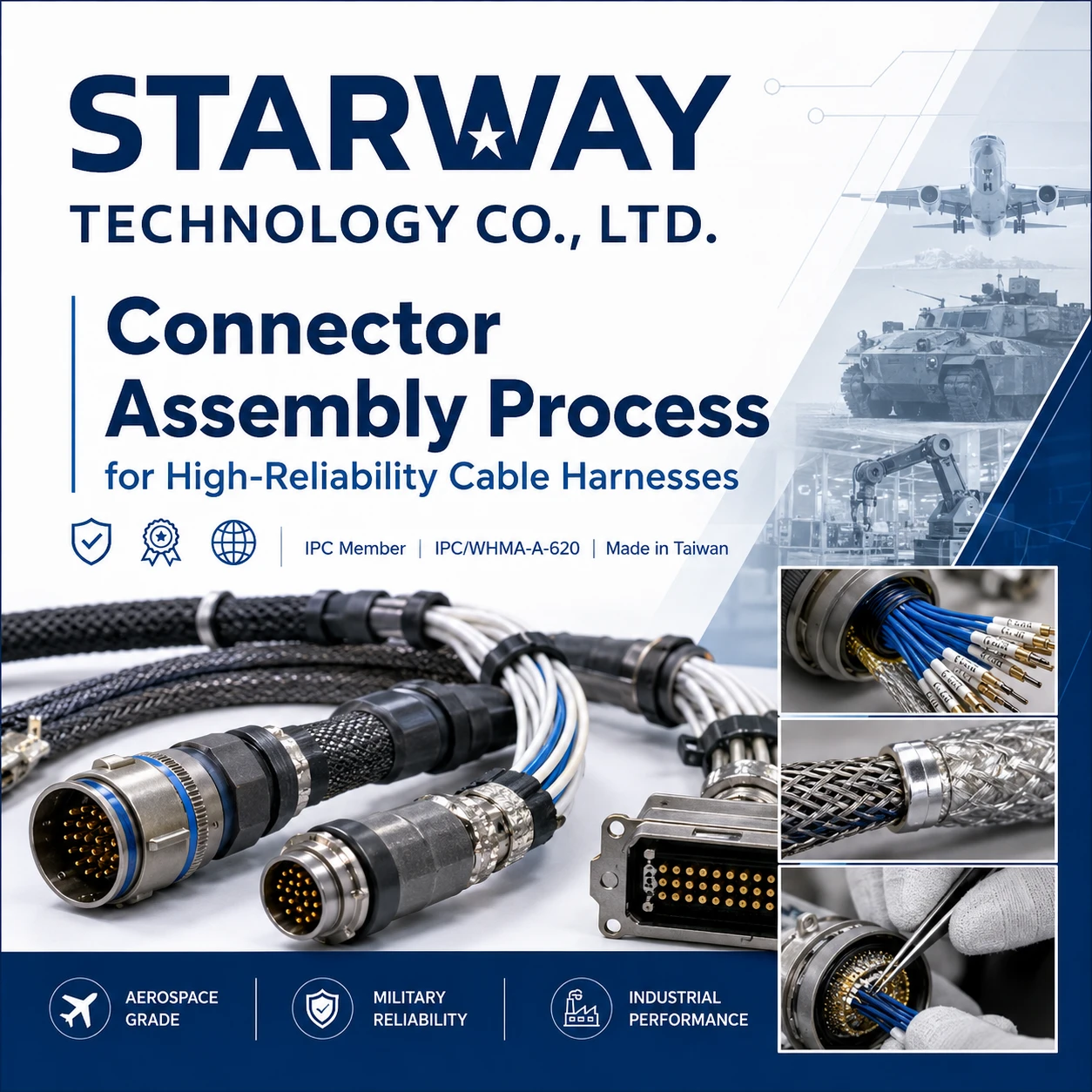
Mechanical VerificationConnector Assembly
Crimped contacts are inserted into connector cavities according to pinout, orientation, lock condition, sealing requirement, and cavity assignment.
ConnectorizationSealing and Protection
Grommet fit, sealing plugs, shrink boots, backshells, heat shrink, potting, overmolding, and material compatibility are reviewed when required.
Leak Path PreventionElectrical Testing
Continuity, pinout verification, open/short testing, contact assignment, and insulation resistance testing are performed according to product requirement.
Electrical VerificationFinal Inspection
Finished harnesses are checked for function, fit, form, labeling, connector condition, sealing condition, wire routing, and protective covering.
Final Quality ReviewPackaging and Shipment
Products are protected, labeled, packed, and released for shipment according to customer requirements to reduce handling and connector damage.
Shipment ControlEnvironmental Sealing and Leak Path Prevention
In high-reliability cable assemblies, defects are not limited to the metal crimp itself. Moisture, oil, fuel, hydraulic fluid, cleaning agents, dust, and vibration can attack the connector-to-cable interface. If the assembly has poor sealing, incorrect grommet fit, missing sealing plugs, weak shrink boot bonding, damaged O-rings, or incompatible overmold materials, the result may be leakage, corrosion, intermittent contact, or complete system failure.
For harsh-environment cable assemblies, Starway Technology reviews sealing-related risks during the manufacturing planning stage. Depending on customer requirements, the assembly may require sealing plugs for unused cavities, careful contact insertion to avoid grommet damage, shrink boot surface preparation, adhesive bonding control, backshell selection, potting, or overmolding process coordination.
- Grommet and Wire Size Matching
- Rear grommet sealing depends on proper wire size and cavity sealing. Undersized wire or empty cavities without sealing plugs may introduce leak paths.
- O-Ring and Seal Handling
- O-rings and peripheral seals must be protected from cuts, compression damage, contamination, incorrect lubrication, or improper installation.
- Shrink Boot Bonding
- Heat-shrink boots require proper cleaning, surface preparation, heat control, adhesive flow, and final inspection to reduce leakage risk.
- Overmolding and Potting
- Overmolding and potting can provide strong environmental protection when material compatibility, surface preparation, curing, and process control are properly managed.
IPC/WHMA-A-620 and IPC/WHMA-A-620E-S Workmanship Awareness
IPC/WHMA-A-620 is an important workmanship reference for cable and wire harness assemblies. It helps manufacturers and customers communicate more clearly about wire preparation, stripping, crimp terminals, soldered terminations, connectorization, shielding, protective coverings, marking, securing, and testing.
Starway Technology: Taiwan-Based Custom Wire Harness OEM Manufacturer
Starway Technology focuses on custom wire harness and cable assembly OEM manufacturing. We are suitable for customers who need small-batch production, high-mix low-volume builds, engineering samples, special connector processing, custom cable assemblies, and stable Taiwan-based production support.
Custom Wire Harness
We manufacture cable assemblies based on customer drawings, samples, BOMs, connector requirements, wire specifications, routing needs, and project-specific production notes.
High-Mix Low-Volume
We support prototypes, engineering samples, low-volume production, customized assemblies, and repeat project-based manufacturing.
Made in Taiwan
Taiwan-based production helps customers maintain direct communication, flexible coordination, responsive engineering discussion, and better process visibility.
Customer Value
For B2B customers, preventing crimping defects directly affects cable assembly reliability, field performance, installation stability, environmental durability, warranty risk, and customer confidence. A supplier that understands wire stripping, crimp geometry, insulation support, terminal-tool matching, leak path prevention, and final testing can help reduce hidden risks before products reach the field.
Starway Technology supports customers with IPC membership, IPC/WHMA-A-620 workmanship awareness, IPC/WHMA-A-620E-S space and military addendum awareness, custom wire harness OEM manufacturing, high-mix low-volume flexibility, crimping defect-prevention thinking, and Taiwan-based production.
FAQ
Q1: What are common crimping defects in cable assembly?
Common defects include nicked strands, broken strands, incorrect strip length, wrong wire placement, weak insulation support, over-crimping, under-crimping, missing bellmouth, wrong terminal-tool-wire combination, and poor environmental sealing.
Q2: Why does strip length matter?
Strip length affects conductor placement, insulation position, conductor brush, and whether the wire barrel grips the conductor correctly. Incorrect strip length can poor electrical or mechanical performance.
Q3: Why is insulation support crimp important?
Insulation support crimp provides strain relief. If it is too loose, it cannot support the wire. If it is too tight, it may crush insulation or damage wire strands.
Q4: How can environmental leakage affect cable assemblies?
Moisture, oil, fuel, chemicals, or dust may enter through leak paths and cause corrosion, insulation failure, intermittent contact, or system malfunction. Sealing plugs, grommets, O-rings, shrink boots, potting, and overmolding can help reduce this risk.
Q5: Is Starway Technology an IPC member?
Yes. Starway Technology is listed in the official Global Electronics Association / IPC member directory as an OEM company.
Q6: Does Starway use IPC/WHMA-A-620?
Starway uses IPC/WHMA-A-620-based workmanship awareness as a reference for cable and wire harness assembly, including wire preparation, crimp terminals, connector assembly, shielding, protective coverings, and testing.
Q7: What is IPC/WHMA-A-620E-S?
IPC/WHMA-A-620E-S is the Space and Military Applications Electronic Hardware Addendum used together with IPC/WHMA-A-620E for higher-reliability cable and wire harness applications.
Q8: Does Starway claim to be formally approved by TE Connectivity or Glenair?
No. Starway Technology references public technical documents from leading interconnect manufacturers to explain professional crimping and sealing process-control principles. Actual manufacturing acceptance follows customer drawings, approved BOMs, connector specifications, terminal specifications, inspection plans, and project-specific agreements.
Q9: Can Starway support high-mix low-volume cable assembly production?
Yes. Starway supports engineering samples, prototypes, customized assemblies, small-batch production, high-mix low-volume projects, and repeat OEM manufacturing.
SEO Keywords
Common Crimping Defects in Cable Assembly and How to Prevent Them, crimping defects, cable assembly defects, wire stripping defects, incorrect strip length, nicked wire strands, broken wire strands, insulation support crimp, over crimping, under crimping, crimp inspection, leak path prevention, environmental sealing, sealing plug, shrink boot, overmolding, custom wire harness manufacturing, cable assembly OEM Taiwan, IPC/WHMA-A-620, IPC/WHMA-A-620E-S Space and Military Applications Electronic Hardware Addendum, IPC member OEM, Starway Technology
Hashtags
Suggested hashtags for article pages, social posts, exhibition content, and SEO support: