首頁 > News > Aerospace & Satellite > How Aerospace Cable Harness Testing and Verification Reduce Mission Risk
How Aerospace Cable Harness Testing and Verification Reduce Mission Risk
How Aerospace Cable Harness Testing and Verification Reduce Mission Risk
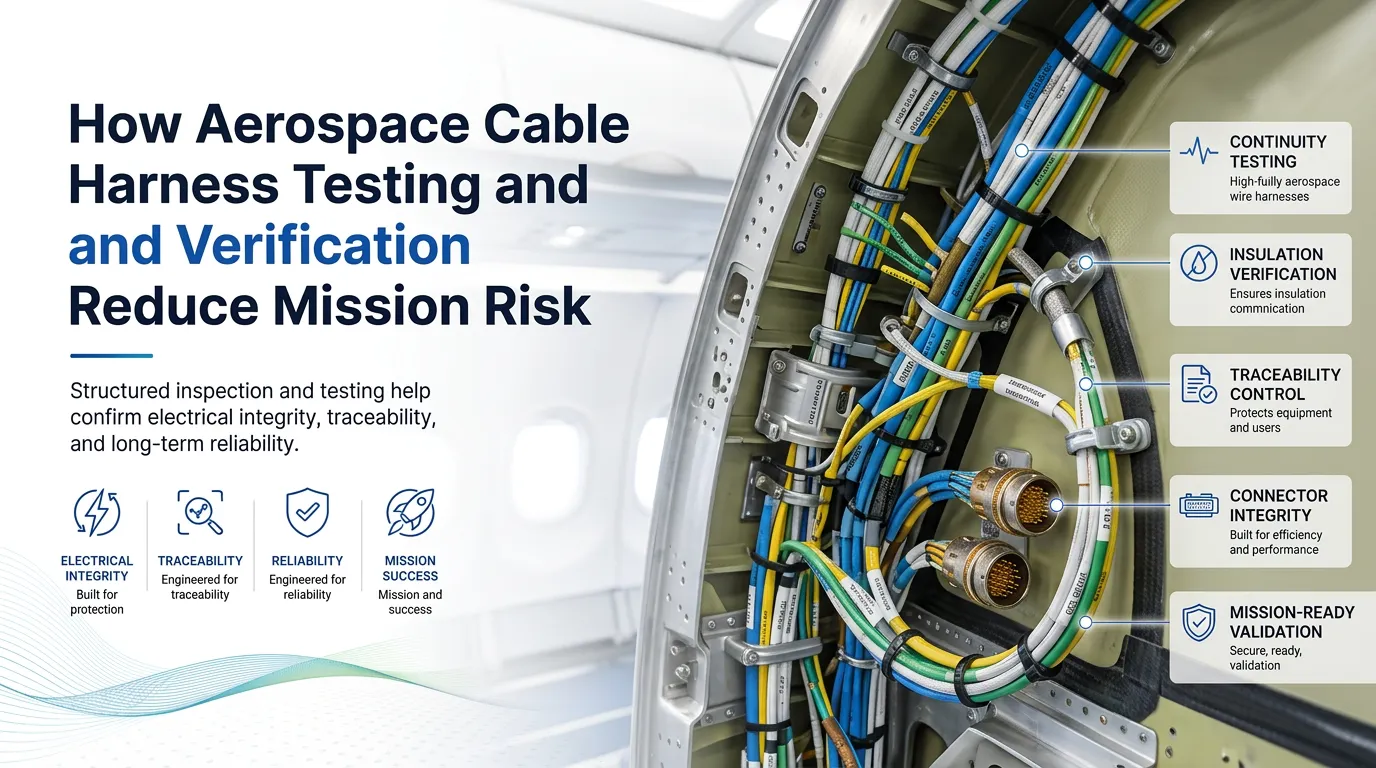
Aerospace cable harness testing and verification help reduce mission risk because they confirm electrical integrity, workmanship consistency, traceable process control, and readiness before deployment.
In aerospace and satellite systems, a cable harness is not validated simply because it looks complete or passes a quick functional check. Mission-critical interconnects must be examined through structured inspection, electrical testing, and documented verification logic.
This matters because late-stage harness defects can affect power routing, signal transmission, subsystem coordination, troubleshooting time, and overall mission confidence. In high-reliability programs, the cost of incomplete verification is often much higher than the cost of disciplined testing.
For this reason, aerospace customers do not evaluate only the finished hardware. They also evaluate whether the supplier can demonstrate repeatable testing methods, reliable workmanship control, inspection readiness, and traceable records that support accountability.
Key Takeaways
- Aerospace harness testing is part of mission-risk control, not only a final quality gate.
- Continuity, insulation resistance, and high-voltage isolation checks help detect hidden defects before installation or launch.
- Visual acceptance alone is not enough to support a strong aerospace reliability claim.
- Verification quality depends on workmanship discipline, calibrated equipment, repeatable procedures, and traceable records.
- Customers often judge suppliers not only by product output, but by how defensible the verification process is under audit or review.
Why Testing and Verification Matter in Aerospace Programs
Aerospace systems operate in environments where vibration, thermal change, limited service access, and long mission duration all increase the consequence of interconnect failure. Under these conditions, a harness cannot be treated as a low-risk commodity item.
Testing and verification reduce uncertainty by confirming that the assembly actually matches design intent, workmanship expectations, and electrical performance requirements. This turns reliability from a claim into something that can be reviewed, recorded, and defended.
The practical lesson is straightforward: when failure cost is high, verification must be built into the manufacturing model rather than added as an afterthought.
Why Visual Acceptance Alone Is Not Enough
A harness may appear clean, organized, and correctly labeled while still containing open circuits, insulation weakness, intermittent contact issues, or miswired positions. Visual inspection is necessary, but it does not replace electrical verification.
This is especially important in aerospace programs because many defects become more difficult to isolate after integration. A problem that is cheap to detect on the bench can become expensive once installed in a dense platform or sealed structure.
That is why strong verification logic combines workmanship review with test evidence, rather than relying on appearance or operator confidence alone.
Core Electrical Tests Used in Aerospace Cable Harness Verification
| Test Type | What It Checks | Why It Matters |
|---|---|---|
| Continuity Testing | Confirms correct point-to-point electrical connection and identifies opens or miswires. | Supports basic functional integrity before higher-level integration. |
| Insulation Resistance Testing | Checks whether insulation performance remains acceptable between conductors and between conductor and ground. | Helps detect contamination, insulation damage, moisture risk, or weakness not visible externally. |
| High-Voltage / Hipot Testing | Applies elevated voltage to evaluate dielectric withstand capability and isolation margin. | Supports confidence that the harness can tolerate electrical stress without breakdown. |
| Pin Assignment Verification | Confirms that each conductor is terminated in the correct position and orientation. | Reduces integration error and helps prevent hidden system-level failures. |
| Record Review and Trace Check | Confirms that the correct revision, lot identity, operator record, and test evidence are linked to the assembly. | Improves accountability, root-cause analysis, and audit readiness. |
How Verification Supports Mission Risk Reduction
Verification reduces mission risk by moving defect discovery earlier, when correction is still practical and controlled. This matters because integration-stage or post-installation failures can affect schedules, rework cost, and confidence in the full system.
A verified harness also improves engineering communication. Instead of debating assumptions, teams can review inspection status, test outputs, and traceable evidence tied to a specific assembly or build lot.
From a business perspective, this lowers downstream uncertainty and strengthens the supplier’s credibility in demanding aerospace programs.
Workmanship, Inspection, and Process Discipline
Testing does not compensate for weak workmanship control. If crimping, routing, strain relief, labeling, cleanliness, or inspection readiness are inconsistent, even a passed test may not fully support long-term reliability confidence.
That is why aerospace verification should be understood as a control model rather than a single step. Workmanship standards, inspection checkpoints, calibrated equipment, and documented acceptance criteria all reinforce each other.
The strongest suppliers are usually the ones who can show not only that they tested the harness, but that they controlled the assembly process leading up to the test.
Traceability and Test Documentation in Aerospace Supply Chains
In aerospace programs, a test result with weak traceability has limited value. Customers often need to know which drawing revision was used, who performed the work, which equipment was used, what settings were applied, and how the record connects to the physical harness.
Traceable documentation helps support audits, failure review, configuration control, and long-term accountability. It also improves internal troubleshooting when a defect pattern must be linked back to a process, component lot, or training issue.
This is one reason aerospace supply chains place higher value on disciplined records than many commercial markets do.
Common Verification Gaps That Increase Harness Risk
| Verification Gap | Risk Created | Practical Result |
|---|---|---|
| Only visual inspection is performed | Hidden electrical defects may remain undetected. | Failure may appear later during integration or operation. |
| Continuity is checked, but insulation is not | Isolation weakness or contamination may be missed. | The harness may pass basic function while still carrying latent risk. |
| Test records are incomplete or unclear | Accountability and audit defense are weakened. | Root-cause analysis becomes slower and less credible. |
| Equipment calibration is not clearly controlled | Confidence in the measurement result is reduced. | Customer trust and verification defensibility decline. |
| Verification is treated as a final-only activity | Earlier process drift may go unnoticed. | Defects are found later, when correction is more costly. |
What Aerospace Customers Actually Evaluate
Customers in aerospace-related markets rarely evaluate only whether a harness passed one test report. They also examine whether the supplier understands design intent, controls workmanship variation, uses appropriate test methods, and keeps records that remain usable under audit.
In other words, they are evaluating verification maturity. A supplier with disciplined inspection and test logic is easier to trust than one that only promises good workmanship without documented evidence.
That is why testing and verification can directly influence not only product acceptance, but also long-term customer confidence.
Frequently Asked Questions
What tests are commonly used for aerospace cable harness verification?
Common verification activities may include continuity testing, insulation resistance testing, high-voltage isolation checks, pin assignment verification, workmanship inspection, and record review based on program requirements.
Why is continuity testing not enough for aerospace applications?
Because continuity confirms connection paths, but it does not by itself prove insulation integrity, dielectric margin, or full verification readiness for high-reliability use.
What does insulation resistance testing help identify?
It helps identify insulation weakness, contamination, moisture-related concerns, or unintended leakage paths that may not be visible during basic visual inspection.
When is high-voltage or hipot testing important in harness validation?
It is important when the application requires confirmation of dielectric withstand capability and electrical isolation margin under elevated voltage conditions defined by the program or customer requirement.
Why do aerospace customers care so much about traceable test records?
Because traceable records support accountability, audit response, root-cause analysis, configuration control, and long-term confidence in the verification process.
How do workmanship standards support verification quality?
They help define consistent acceptance logic for crimping, wiring, cable handling, inspection discipline, and process control, which makes the verification result more credible and repeatable.
Official References
The following references provide additional context on aerospace cable harness workmanship, verification logic, inspection methods, and high-reliability electrical interconnect practice.
- NASA-STD-8739.4: Workmanship Standard for Crimping, Interconnecting Cables, Harnesses, and Wiring
- IPC/WHMA-A-620E: Requirements and Acceptance for Cable and Wire Harness Assemblies
- IPC/WHMA-A-620 Space: NASA Recognition and Training Context for Flight Hardware Inspection
- ECSS-E-10-02A: Verification
- MIL-DTL-38999: Circular, High Density, Environment Resistant Electrical Connectors