首頁 > News > Aerospace & Satellite > Why High-Reliability Wire Harnesses Matter in Aerospace and Satellite Systems
Why High-Reliability Wire Harnesses Matter in Aerospace and Satellite Systems
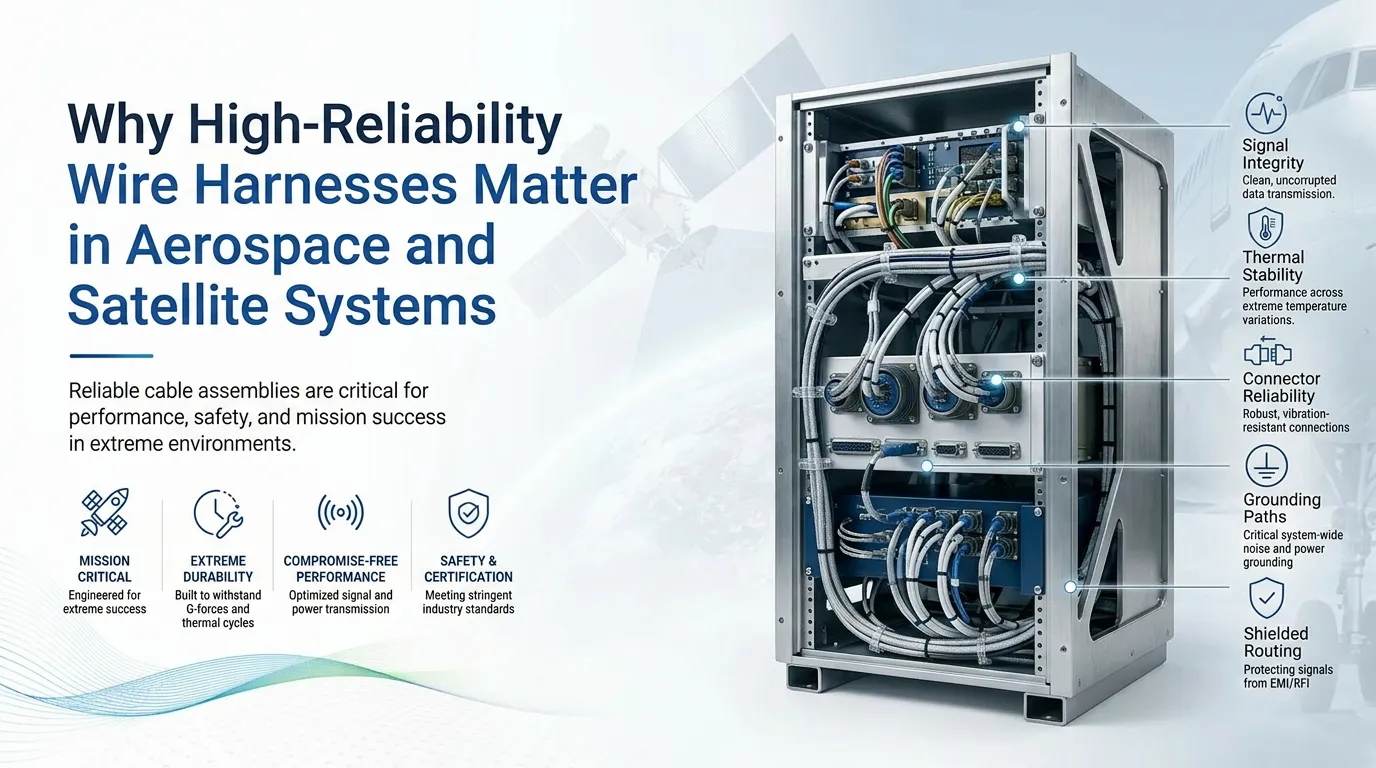
Why High-Reliability Wire Harnesses Matter in Aerospace and Satellite Systems
High-reliability wire harnesses are essential in aerospace and satellite systems because they support stable power delivery, signal transmission, and subsystem integration under demanding environmental and operational conditions.
Aerospace and satellite platforms depend on electrical interconnect systems that must continue to function under vibration, temperature variation, confined installation space, and long mission durations.
In these environments, wire harnesses are not passive accessories. They are part of the system architecture that supports communication, control, power routing, and mission continuity.
As aerospace missions become more advanced, the reliability of the harness system becomes more important, not less. When maintenance access is limited and failure consequences are high, interconnect design must prioritize stability, routing discipline, workmanship control, and verification from the start.
Key Takeaways
- Aerospace and satellite systems require harnesses that support power, signal, and subsystem connectivity under harsh operating conditions.
- Integrated spacecraft functions rely on dependable electrical interconnect architecture.
- Reliable harness design helps reduce connection risk, improve inspection efficiency, and support long-term system stability.
- Workmanship control, traceability, and verification discipline are critical in high-reliability applications.
- As mission complexity increases, interconnect reliability becomes a core engineering requirement rather than a secondary assembly concern.
Why Aerospace Harnesses Face Higher Demands
In aerospace and satellite environments, electrical interconnect systems must operate reliably where vibration, thermal variation, mechanical constraints, and mission-critical performance all interact.
This is fundamentally different from ordinary commercial wiring because the system often cannot be serviced easily once deployed. That changes the engineering logic: design margin, routing discipline, termination quality, and traceability become operational requirements rather than optional quality improvements.
As aerospace programs become more advanced, the harness system plays a larger role in protecting system integrity across longer and more demanding mission profiles.
Core Operating Factors in Aerospace and Satellite Platforms
| Operating Factor | Why It Matters | Harness Engineering Impact |
|---|---|---|
| Vibration and Mechanical Stress | Launch, movement, and dynamic operating conditions can affect interconnect stability. | Routing, fixation, strain relief, and termination integrity become critical. |
| Thermal Variation | Temperature changes influence materials, insulation behavior, and connection reliability. | Material selection and workmanship consistency require tighter control. |
| Limited Installation Space | Spacecraft and airborne systems often integrate dense subsystems in compact structures. | Harness design must balance routing efficiency, service access, and electrical separation. |
| Long Mission Duration | System stability must be maintained over extended operating periods. | Reliability and process discipline matter more than low initial assembly cost. |
Why Interconnect Architecture Matters
In aerospace applications, interconnect solutions do more than connect components. They support the coordinated operation of power systems, control systems, communications, sensing, and subsystem integration.
When multiple mission-critical functions depend on stable interconnections, harness architecture directly affects whether the platform can perform as intended.
For this reason, aerospace harness design should be treated as part of system engineering, not only as a manufacturing task.
Connector-Specific Harness Design Considerations
Generic wiring logic is usually insufficient for aerospace-grade applications because connector interfaces, routing geometry, shielding needs, and service conditions vary by subsystem.
A connector may meet electrical requirements on paper but still failure risk if termination quality, strain relief, or inspection access are poorly controlled.
That is why connector-specific harness design should be treated as a system integration issue rather than only a sourcing decision.
| Design Focus | Why It Matters | Practical Effect |
|---|---|---|
| Termination Quality | Connection stability depends heavily on workmanship consistency. | Better termination control supports dependable electrical performance. |
| Strain Relief | Mechanical stress often accumulates near connection points. | Proper support helps protect long-term connection integrity. |
| Inspection Accessibility | Quality verification becomes harder when inspection points are poorly planned. | Inspection-friendly design supports stronger process control. |
| Routing Discipline | Dense platforms require organized cable paths and interface planning. | Better routing improves serviceability and reduces assembly complexity. |
Where Harnesses Are Used in Aerospace and Satellite Systems
Aerospace and satellite harnesses are used wherever power, control, sensing, or communication signals must move reliably between subsystems.
These applications can include power distribution, communications links, subsystem control interfaces, thermal management support, and test or validation equipment.
The common requirement across all of these use cases is that electrical performance must remain stable under conditions where access, repair, and replacement may be limited.
| Application Area | Typical Function | Why Reliability Matters |
|---|---|---|
| Power Distribution Systems | Support electrical power delivery across major subsystems. | Power instability can affect multiple functions at once. |
| Communications and Data Links | Carry signals used for control, navigation, and data transmission. | Signal interruption can affect system coordination and visibility. |
| Subsystem Control Interfaces | Connect sensors, control units, and operational modules. | Stable interconnects are required for predictable system behavior. |
| Thermal and Environmental Control Support | Assist system-level functions that help maintain operating conditions. | Environmental performance is linked to broader platform reliability. |
| Ground Test and Validation Equipment | Support inspection, verification, and production testing. | Early defect detection helps reduce downstream risk. |
Common Harness Failure Risks in Aerospace Systems
In high-reliability aerospace environments, failure often emerges from accumulated design, assembly, and process-control weaknesses rather than from one obvious defect.
Crimp inconsistency, solder termination issues, insufficient strain relief, weak inspection discipline, and limited traceability can all increase long-term reliability risk.
That is why aerospace harness manufacturing should be managed through repeatable workmanship standards, inspection discipline, and process accountability.
| Risk Area | Engineering Concern | Why It Matters |
|---|---|---|
| Crimp Inconsistency | Variable crimp quality can affect electrical and mechanical stability. | Small workmanship variation can larger reliability risk. |
| Solder Termination Issues | Weak or inconsistent soldering can reduce long-term dependability. | Termination defects often become system-level problems later. |
| Insufficient Strain Relief | Mechanical loads can concentrate near interfaces. | This increases the chance of damage during vibration or handling. |
| Weak Inspection Discipline | Poor inspection reduces early defect detection. | Late-stage problems are more expensive and harder to isolate. |
| Limited Traceability | Incomplete records weaken process visibility. | Root-cause analysis and accountability become more difficult. |
Design Considerations for Aerospace and Satellite Cable Assemblies
Aerospace harness design should be evaluated through several practical questions: can the system tolerate the operating environment, maintain signal and power stability, support inspection, remain testable, and preserve traceability through production.
If one of these dimensions is weak, the overall reliability claim becomes difficult to defend.
This is why process capability alone is not enough; design, workmanship, and verification must work together as one control model.
| Design Priority | Engineering Objective | Business Meaning |
|---|---|---|
| Routing and Layout Control | Support organized integration in compact system environments. | Better planning reduces assembly risk and rework burden. |
| Termination Workmanship | Maintain stable and repeatable connection quality. | Higher consistency supports customer confidence. |
| Inspection Readiness | Make quality verification more repeatable and efficient. | Inspection-friendly design lowers hidden quality risk. |
| Traceability | Maintain process visibility and accountability. | Stronger records improve control in demanding supply chains. |
| Reliability Margin | Design for environments where repair access is limited. | This reduces lifecycle risk where failure cost is high. |
Why Reliability and Verification Standards Matter
In aerospace and satellite applications, quality is not judged only by whether an assembly works once. The more important question is whether it can perform consistently under demanding conditions and whether the build process is repeatable and verifiable.
That is why workmanship control, inspection discipline, and documented process consistency are central to high-reliability interconnect manufacturing.
For companies serving aerospace-related markets, the real differentiator is often not simple production capacity but the ability to control detail, reduce variation, and support long-term reliability expectations.
Frequently Asked Questions
What makes aerospace wire harnesses different from general industrial harnesses?
Aerospace applications place heavier emphasis on environmental resistance, workmanship control, inspection rigor, and reliability in systems where maintenance access may be limited.
Why is harness reliability important in satellite and spacecraft systems?
Because stable interconnect performance directly affects power delivery, signal transmission, subsystem coordination, and overall platform dependability.
Does aerospace harness design only depend on materials and connectors?
No. Routing, termination quality, strain relief, inspection readiness, and traceability also play important roles in the overall reliability of the assembly.
Why are workmanship and verification so important?
Because in high-reliability applications, small process variations can become larger system risks over time, especially when repair access is limited or impossible.
What is the practical lesson for manufacturers serving aerospace customers?
Customers are not only evaluating product specifications. They are also evaluating process consistency, inspection discipline, and whether the supplier understands system-level reliability risk.
Related Reading
- Green Energy Applications and High-Reliability Wire Harness Design
- Industrial Interconnect Solutions for Harsh Operating Environments
- Why Process Control Matters in High-Reliability Cable Assembly Manufacturing
Official References
The following references provide additional context on aerospace and satellite cable harness workmanship, high-reliability assembly requirements, connector standards, and aerospace harness manufacturing practice.
- NASA-STD-8739.4: Workmanship Standard for Crimping, Interconnecting Cables, Harnesses, and Wiring
- NASA-STD-8739.4A PDF: Crimping, Interconnecting Cables, Harnesses, and Wiring
- ECSS-Q-ST-70-61C: High Reliability Assembly for Surface Mount and Through Hole Connections
- MIL-DTL-38999: Circular, High Density, Environment Resistant Electrical Connectors
- TASA: Harness Design and Manufacturing