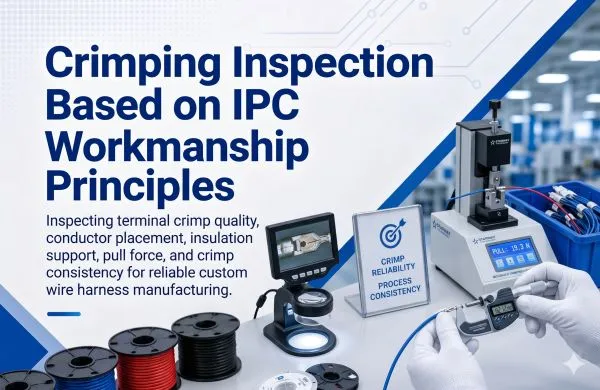
Crimping Inspection Based on IPC Workmanship Principles
Inspecting terminal crimp quality, conductor placement, insulation support, crimp height, pull force, and process consistency for reliable custom wire harness manufacturing.
Crimping inspection based on IPC workmanship principles is the process of checking terminal crimp appearance, conductor positioning, insulation support, crimp height where required, pull force where required, and overall crimping consistency before the wire harness moves into connector loading, routing, assembly, electrical testing, or final inspection.
In custom wire harness manufacturing, crimping is one of the most important control points because the crimped connection must provide stable electrical contact and reliable mechanical retention.
Technical Summary
Starway Technology provides custom wire harness manufacturing support with crimping inspection focused on terminal compatibility, conductor crimp condition, insulation crimp support, crimp height verification where required, pull force testing where required, and traceable process control.
This crimping inspection approach supports IPC/WHMA-A-620-based workmanship thinking by helping verify that the terminal, conductor, insulation, tooling, and production process are suitable before connector loading, assembly, electrical testing, and final inspection. For aerospace, defense, industrial automation, advanced communications, and other high-reliability applications, stable crimping helps reduce intermittent contact, weak terminal retention, conductor damage, and downstream test failures.
Why Crimping Inspection Matters
In custom wire harness manufacturing, crimping quality directly affects electrical continuity, mechanical retention, contact stability, and long-term harness reliability. A poor crimp may look acceptable at first glance, but it can lead to intermittent connection issues, high resistance, weak pull strength, or field failure under vibration, movement, or repeated handling.
Starway Technology Co., Ltd. applies IPC-based workmanship thinking and project-specific crimping inspection control to reduce connection-related risk before the wire harness enters connector assembly, routing, sleeving, or final testing.
Crimp Appearance Review
Terminal crimp shape, conductor position, insulation support, bellmouth condition, and visible deformation are reviewed before downstream assembly.
Mechanical Retention Control
Pull force or retention checks can be performed where required by customer specifications, terminal requirements, or project requirements.
Crimping Traceability
Crimping inspection records can support quality review, troubleshooting, process control, and repeat manufacturing.
What We Check During Crimping Inspection
Crimping inspection confirms that the terminal, conductor, insulation, tooling, and crimping process are suitable before the wire harness continues to connector insertion, assembly, electrical testing, or final inspection.
- Terminal and Wire Compatibility
- Terminal part number, wire gauge, conductor size, insulation diameter, applicator suitability, strip length, and project requirements are checked before crimping begins.
- Conductor Crimp Condition
- The conductor crimp is checked for conductor placement, strand visibility, bellmouth condition, cut-off tab condition, crimp deformation, strand damage, and overall crimp appearance.
- Insulation Crimp Support
- Insulation support is reviewed to confirm that the insulation is properly held without excessive compression, loose retention, insulation cracking, or improper positioning.
- Crimp Height and Width
- Crimp height, crimp width, and dimensional consistency can be checked using suitable measuring equipment according to terminal specifications, applicator settings, customer drawings, or project requirements.
- Pull Force Verification
- Pull force testing can be performed to verify mechanical retention between the crimped terminal and conductor when specified by customer requirements, terminal requirements, or internal process control.
- Crimping Process Consistency
- Crimping consistency is reviewed through first-piece confirmation, sample checks, visual inspection, tooling condition review, applicator condition review, and production record control where required.
Common Crimping Risks
Incorrect Terminal or Wire Match
A terminal that does not match the wire size, insulation diameter, or conductor type may lead to poor crimp formation, weak retention, or unstable electrical contact.
Poor Conductor Position
Improper conductor placement may affect strand capture, crimp compression, electrical continuity, and mechanical strength.
Insufficient Insulation Support
Loose, over-compressed, cracked, or mispositioned insulation support may reduce strain relief and increase the risk of conductor fatigue.
Unstable Crimping Process
Tooling wear, incorrect applicator setup, inconsistent strip length, or insufficient first-piece control may repeated crimping variation.
IPC-Based Workmanship Approach
As an IPC Association member, Starway Technology applies IPC-based workmanship principles across custom wire harness manufacturing, including wire preparation, crimping control, connector assembly, electrical testing, and final inspection.
Crimping inspection is reviewed as a critical control point because the crimped connection must provide both electrical contact and mechanical retention. For high-reliability applications, stable crimping helps reduce intermittent contact, loose terminal retention, conductor damage, high resistance, and downstream testing failures.
Relevant workmanship references may include IPC/WHMA-A-620 for cable and wire harness assemblies, IPC/WHMA-A-620 space and military application addendum references where specified by the customer, IPC-A-610 for electronic assembly acceptance criteria, and J-STD-001 for soldered electrical and electronic assemblies where applicable.
These references do not replace customer drawings, terminal manufacturer specifications, applicator settings, or project requirements. Instead, they provide a workmanship framework that helps strengthen inspection awareness, production control, and technical communication between the customer and manufacturer.
Customer Value
Controlled crimping inspection helps customers reduce intermittent connection risk, improve electrical stability, support mechanical retention, and maintain repeatable production quality for custom wire harness projects. This approach is especially valuable for aerospace, defense, industrial automation, advanced communications, and other high-reliability applications where terminal crimp quality can directly affect system performance, serviceability, and long-term reliability.
Starway Technology Quality Summary
FAQ
What is crimping inspection in wire harness manufacturing?
Crimping inspection is the process of checking terminal crimp quality, conductor placement, insulation support, crimp deformation, crimp height where required, and pull force where required before the harness moves to connector assembly, electrical testing, or final inspection.
Why is crimping quality important for custom wire harnesses?
Crimping quality affects electrical continuity, mechanical retention, contact stability, and long-term wire harness reliability. Poor crimping can cause intermittent connection issues, weak pull strength, high resistance, or downstream test failures.
Does Starway use IPC workmanship principles for crimping inspection?
Starway applies IPC-based workmanship thinking as a reference for process control, crimping inspection, assembly quality, and traceable manufacturing, including references such as IPC/WHMA-A-620 where applicable.
What crimping items are usually inspected?
Common inspection items include terminal and wire compatibility, conductor crimp condition, insulation support, bellmouth condition, cut-off tab condition, crimp height, crimp width, pull force, tooling condition, and process consistency.