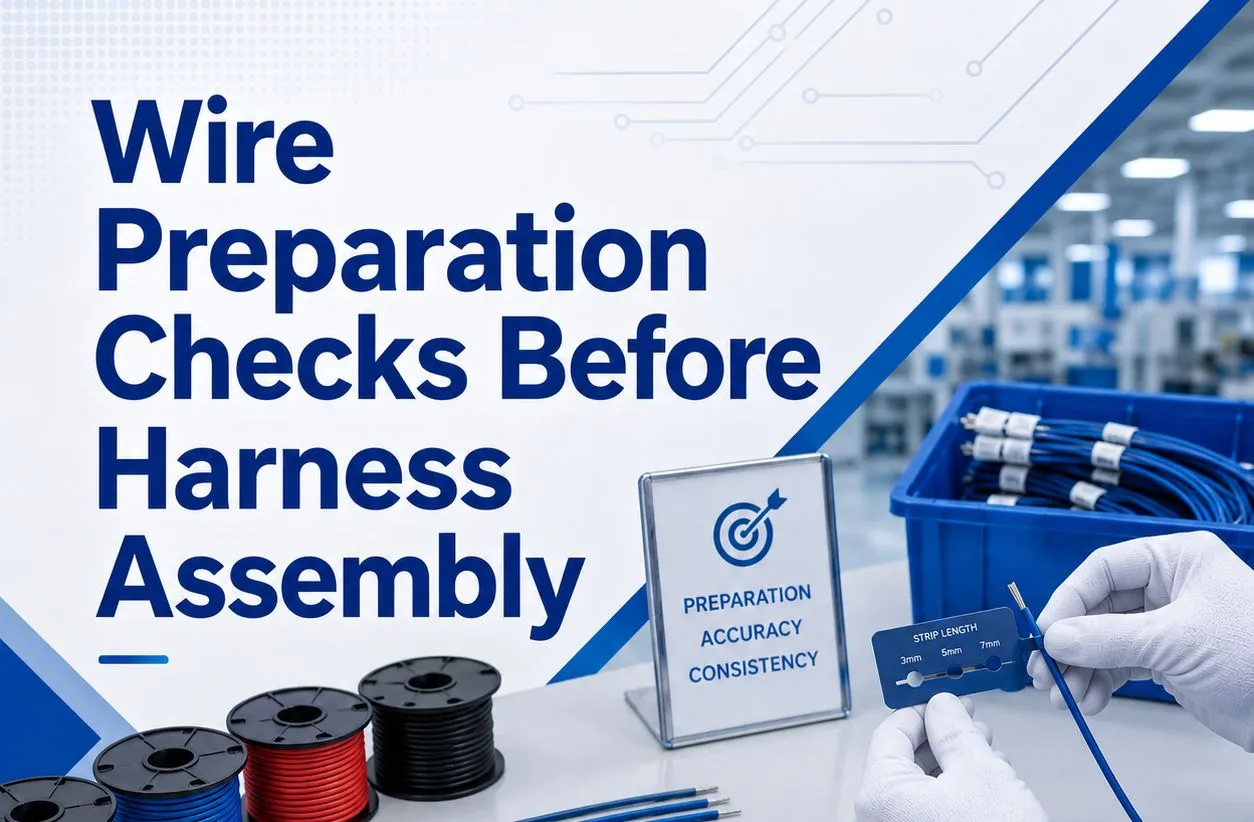
Wire Preparation Checks Before Harness Assembly
Verifying wire cutting length, stripping length, insulation condition, conductor quality, wire marking, and preparation consistency before harness assembly begins.
Wire preparation checks before harness assembly are the inspection steps used to verify cut length, strip length, conductor condition, insulation quality, wire marking, and preparation consistency before crimping, soldering where applicable, connector loading, routing, sleeving, or final wire harness assembly begins.
In custom wire harness manufacturing, wire preparation is a critical in-process control point because errors at this stage may affect crimp quality, conductor retention, insulation support, connector assembly, circuit identification, and final electrical performance.
Technical Summary
Starway Technology provides custom wire harness manufacturing support with wire preparation checks covering cutting length, stripping length, conductor condition, insulation quality, wire marking, and preparation consistency. These checks help confirm that prepared wires are suitable before crimping, soldering where applicable, connector loading, routing, sleeving, labeling, and final harness assembly.
This preparation control supports IPC/WHMA-A-620-based workmanship thinking by reducing preparation-related defects before they move into later assembly stages. For aerospace, defense, industrial automation, advanced communications, and other high-reliability applications, stable wire preparation helps improve repeatability, inspection clarity, and final harness reliability.
Why Wire Preparation Checks Matter
In custom wire harness manufacturing, wire preparation directly affects crimping quality, connector assembly accuracy, electrical performance, routing consistency, and final harness reliability. If wires are cut too short, stripped too long, damaged during preparation, or marked incorrectly, the problem may not appear until later assembly or final testing.
Starway Technology Co., Ltd. applies IPC-based workmanship thinking and project-specific inspection control to reduce preparation-related defects before the wire harness enters the crimping and assembly stage.
Cut Length Control
Wire length is checked against customer drawings, BOM details, harness layout requirements, and production specifications.
Strip Quality Inspection
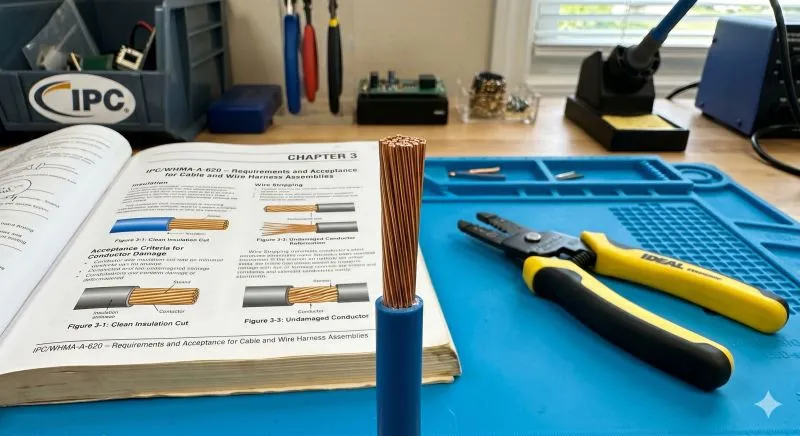
Stripping length, insulation condition, conductor exposure, and possible strand damage are reviewed before assembly.
Preparation Traceability
Wire preparation checks can support in-process inspection records, quality review, troubleshooting, and repeat manufacturing.
What We Check Before Harness Assembly
Wire preparation checks confirm that each prepared wire is suitable for the next manufacturing stage, including crimping, soldering where applicable, connector insertion, routing, sleeving, labeling, and final harness assembly.
- Wire Cutting Length
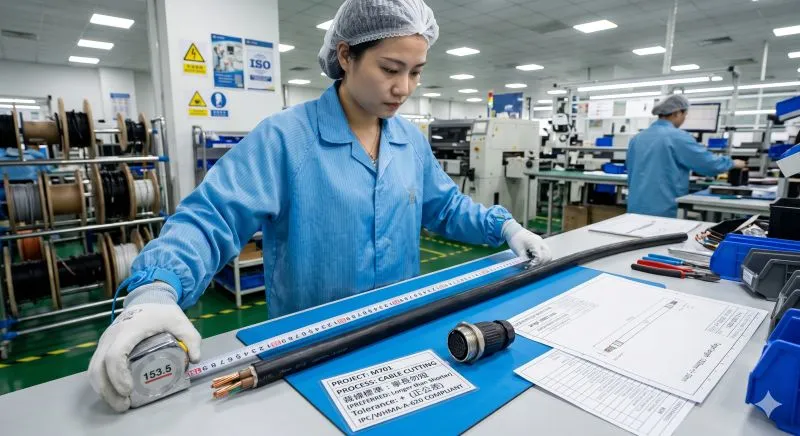
- Visual inspection and measuring tools such as a steel ruler or measuring tape may be used to confirm wire cutting length against customer drawings, BOM details, harness layout requirements, and production specifications. The cutting length used by the manufacturer may differ from the final visible wire length because connector insertion, termination, routing allowance, and assembly requirements must also be considered.
- Wire Stripping Length
- Visual inspection, Vernier calipers, and suitable stripping tools may be used to review strip length, insulation condition, exposed conductor length, and possible strand damage before crimping or soldering where applicable.
- Conductor Condition
- Conductors are checked for broken strands, nicked wires, deformation, oxidation, contamination, loose strands, or other preparation-related defects that may affect crimping, soldering, or electrical reliability.
- Insulation Condition
- Insulation is checked for cuts, compression marks, heat damage, deformation, cracking, stripping marks, or other defects that may affect insulation support, routing stability, or long-term product reliability.
- Wire Marking and Identification
- Wire color, printed marking, label position, sleeve marking, circuit identification, and customer-specific identification requirements are verified to reduce assembly and troubleshooting errors.
- Preparation Consistency
- Prepared wires are reviewed for batch consistency, routing readiness, kit completeness, revision alignment, and readiness for harness assembly.
Common Wire Preparation Risks
Cut Length Too Short
A wire that is cut too short may not meet routing requirements, connector position requirements, strain relief needs, or final assembly dimensions.
Incorrect Strip Length
Excessive or insufficient strip length may affect conductor insertion, crimp height, insulation support, soldering control, or exposed conductor condition.
Conductor Strand Damage
Nicked, cut, broken, oxidized, or contaminated conductor strands may reduce mechanical retention, electrical performance, or long-term connection stability.
Wrong Wire Identification
Incorrect wire color, marking, circuit label, or sleeve identification may cause assembly errors, inspection delays, or troubleshooting difficulty.
IPC-Based Workmanship Approach
As an IPC Association member, Starway Technology applies IPC-based workmanship principles across custom wire harness manufacturing, including wire preparation, material handling, crimping control, connector assembly, electrical testing, and final inspection.
Wire preparation is reviewed not only as a cutting or stripping operation, but also as a critical control point that affects later crimping quality, conductor retention, insulation support, connector loading, circuit identification, and final wire harness reliability.
Relevant workmanship references may include IPC/WHMA-A-620 for cable and wire harness assemblies, IPC/WHMA-A-620 space and military application addendum references where specified by the customer, IPC-A-610 for electronic assembly acceptance criteria, and J-STD-001 for soldered electrical and electronic assemblies where applicable.
These references do not replace customer drawings, BOM details, or project specifications. Instead, they provide a workmanship framework that helps strengthen inspection awareness, production control, and technical communication between the customer and manufacturer.
Customer Value
Controlled wire preparation checks help customers reduce assembly risk, improve crimping consistency, prevent conductor damage, and support repeat manufacturing for custom wire harness projects. This approach is especially valuable for aerospace, defense, industrial automation, advanced communications, and other high-reliability applications where wire length, strip quality, circuit identification, and preparation consistency can affect final product performance.
Starway Technology Quality Summary
FAQ
What are wire preparation checks before harness assembly?
Wire preparation checks are the inspection steps used to verify wire cutting length, stripping length, conductor condition, insulation quality, marking accuracy, and preparation consistency before crimping, soldering where applicable, connector loading, or final harness assembly begins.
Why is wire preparation important in custom wire harness manufacturing?
Wire preparation affects crimping quality, connector assembly, circuit identification, electrical performance, and final harness consistency. Errors at this stage can cause downstream production problems and may be harder to correct after assembly.
Does Starway use IPC standards for wire preparation checks?
Starway applies IPC-based workmanship thinking as a reference for process control, inspection awareness, assembly quality, and traceable manufacturing, including references such as IPC/WHMA-A-620 where applicable.
What wire preparation items are usually inspected?
Common inspection items include cutting length, stripping length, conductor condition, insulation condition, wire color, printed marking, label position, sleeve marking, circuit identification, and preparation consistency.