首頁 > News > Industrial Sector > Top 10 Global Wire Harness Industry News from Sep 29 to Oct 26, 2026.
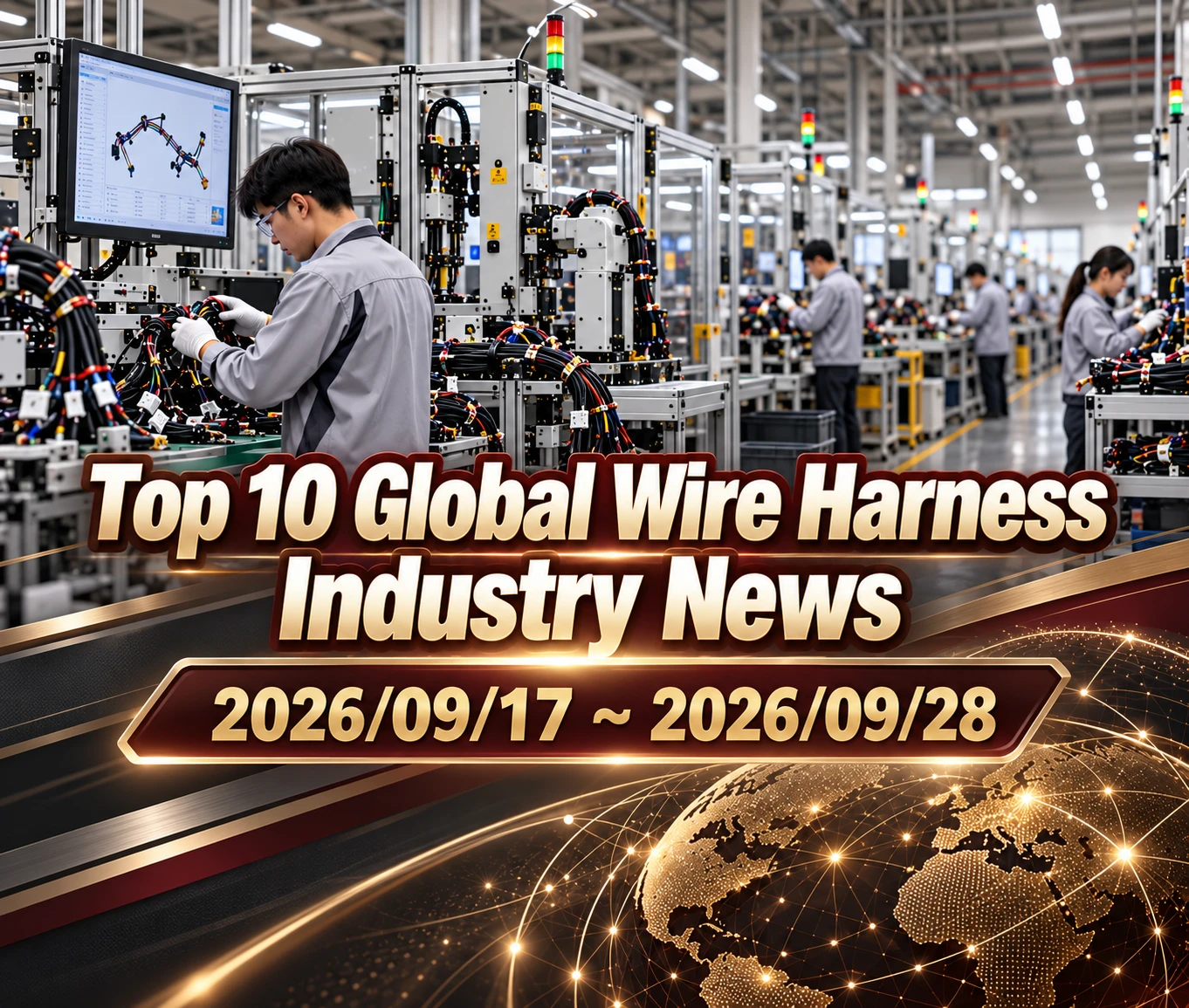
Top 10 Global Wire Harness Industry News from Sep 29 to Oct 26, 2026.
Top 10 Global Wire Harness Industry News
September 29 to October 26, 2026
From late September to late October 2026, the global wire harness and connector industry focused on manufacturing automation and near-shoring, the shift toward fiber, 48V and high-power AI data-center connectivity, and new capacity and robotic automation initiatives across automotive, aerospace and defense supply chains.
Factory localization, variant reduction, robotics, and digital work instructions are moving wire-harness production toward more repeatable and regionally responsive manufacturing.
Automotive fiber optics, 48V power distribution, 800V/400Vdc AI power, liquid cooling, and 1.6T links are raising both electrical and assembly requirements.
Domestic capacity, defense automation, traceability, and robust connector systems are becoming more important across aerospace, UAS, industrial, and battery-powered applications.
Key Industry Events and Manufacturing Implications
01 | Kromberg & Schubert Opens Béja 2 Wiring-Harness Plant in Tunisia
Kromberg & Schubert | Near-Shore Automotive Harness Manufacturing | 2026-10-01 to 2026-10-02INDUSTRY DYNAMICS AND IMPACT
German wiring-system supplier Kromberg & Schubert inaugurated its second automotive wiring-harness facility in Béja, north-western Tunisia. The 60,000 m² site represents an initial investment of about TND 270 million, or nearly €80 million, for construction and equipment, with the workforce planned to rise gradually to around 7,500 by 2029. The plant is intended in particular to support the automotive industry's transition to electric vehicles and demand from German manufacturers. The expansion reinforces North Africa's role as a near-shore manufacturing base for European automotive wiring supply chains.
STARWAY PERSPECTIVE
Near-shore expansion can shorten response time and improve regional supply resilience, but multi-site programs still depend on consistent work instructions, terminal and wire specifications, inspection criteria, and traceability so quality remains aligned across locations.
02 | Mazda and Yazaki Cut CX-5 Harness Variants by About 80% Through Near-Site and Automated Production
Mazda & Yazaki | Harness Simplification and Near-Site Automation | 2026-10-15INDUSTRY DYNAMICS AND IMPACT
Mazda Motor Corporation and Yazaki Corporation announced the first vehicle application of results from their co-creation program for near-site and more automated wire-harness production, which began in early 2022. For the all-new MAZDA CX-5, the two companies jointly reviewed vehicle design, harness specifications, structures and manufacturing processes, reducing the number of wire-harness variants by approximately 80% versus the previous model. Finished harnesses are produced by a Yazaki affiliate in Mine City, Yamaguchi, for Mazda's Hiroshima and Yamaguchi assembly plants. The case highlights how reducing harness complexity can make automation and localized supply more practical.
STARWAY PERSPECTIVE
Variant reduction is a strong enabler for automation. Harness manufacturers should therefore treat design simplification, connector commonality, branch standardization, and controlled change management as manufacturing inputs rather than only engineering decisions.
03 | Q5D Launches £6.27 Million AutoLoom Project for Digitally Driven Automated Wiring Production
Q5D Technologies | Automated Harness Manufacturing | 2026-10-01INDUSTRY DYNAMICS AND IMPACT
UK-based Q5D Technologies launched AutoLoom, a £6,274,548 collaborative project supported by the DRIVE35 Innovation Fund. Q5D is leading the program with Warwick Manufacturing Group, Artifex of Tata AutoComp, and a major UK vehicle manufacturer. The project will establish a production-representative automated wiring line capable of producing conventional flat harnesses and pre-wired vehicle components directly from digital design data. By replacing labor-intensive manual assembly with software- and robotics-led processes, AutoLoom aims to improve flexibility, localization and supply-chain resilience for electric and software-defined vehicles.
STARWAY PERSPECTIVE
Direct digital-to-production workflows reduce manual interpretation, but only when engineering data is structured and stable. Clean BOMs, connector definitions, wire-route data, revision control, and machine-readable work instructions will become increasingly important.
04 | Zuken Releases Harness Builder 2027 With Production Dashboard and Digital Work-Instruction Tracking
Zuken | Digital Manufacturing and E3.series | 2026-09-29INDUSTRY DYNAMICS AND IMPACT
Zuken announced Harness Builder 2027 for E3.series, adding a Dashboard that brings production data from Assembly Task Manager into a shared view for supervisors, production managers and shop-floor technicians. Teams can monitor active wire-harness builds, completion progress, dates, technician information and task timestamps as work is completed. The release also expands quantity and subproject estimating, BOM/Wire Run List/splice-table controls, and modeling for connectors with inserts and cable-protection materials such as tubing, loom, sleeving and overbraid. The update illustrates the continuing shift toward a connected digital thread from harness engineering to manufacturing.
STARWAY PERSPECTIVE
A connected digital thread can reduce handoff errors between engineering and production. For high-mix, low-volume builds, real-time task status and revision visibility are especially useful for preventing obsolete instructions or mismatched BOM information from reaching the shop floor.
05 | Rosenberger Introduces GFC Automotive Optical Connectivity Above 50 Gbps Over Distances Up to 40 Meters
Rosenberger | Automotive Fiber-Optic Connectivity | 2026-10-01INDUSTRY DYNAMICS AND IMPACT
Rosenberger introduced GFC (Glass Fiber Connector), a next-generation optical connectivity standard for in-vehicle data communication. The company states that GFC supports data rates above 50 Gbps over transmission distances of up to 40 meters and is compliant with IEEE 802.3cz. As centralized computing, zonal controllers, high-resolution cameras and sensors increase the amount of data moving through vehicles, copper links face growing bandwidth, weight and EMC constraints. Fiber-optic links are therefore emerging as an important option for high-speed automotive backbones and next-generation data harnesses.
STARWAY PERSPECTIVE
Moving from copper to fiber changes the manufacturing risk profile. Cleanliness, end-face protection, minimum bend radius, connector handling, optical loss inspection, and routing control must be built into assembly and inspection procedures from the prototype stage.
06 | BizLink Showcases 800V/400Vdc Power, Liquid Cooling and 1.6T Interconnects for AI Data Centers
BizLink | AI Data-Center Power and High-Speed Interconnects | 2026-10-07INDUSTRY DYNAMICS AND IMPACT
BizLink announced an integrated portfolio for high-density AI infrastructure at OCP Global Summit 2026, covering power, high-speed copper, optical interconnects, rack monitoring and liquid cooling. The showcase includes 800V/400Vdc high-power interconnects for OCP and NVIDIA MGX rack solutions, liquid-cooled integrated designs, PCIe Gen6 DA-CEM, EDSFF Hybrid and MCIO-AC cable assemblies, plus 448G bulk cable and 1.6T connectivity. The announcement shows how cable-assembly and interconnect demand is expanding beyond traditional industrial and automotive applications into AI servers and high-power data-center infrastructure.
STARWAY PERSPECTIVE
AI infrastructure combines high current, high data rate, dense packaging, and thermal management. Cable-assembly suppliers increasingly need to coordinate electrical performance, connector retention, shielding, routing, and cooling interfaces as one integrated manufacturing problem.
07 | ICTC Acquires Trinity Manufacturing to Expand U.S. Cable and Wire-Harness Capacity
ICTC | U.S. Domestic Manufacturing and Ground-Support Harnesses | 2026-10-07 to 2026-10-08INDUSTRY DYNAMICS AND IMPACT
Interconnect Cable Technologies Corporation (ICTC) announced the acquisition of Trinity Manufacturing Corporation, a cable and wire-harness manufacturer based in Bradenton, Florida. The transaction expands ICTC's domestic manufacturing footprint and U.S.-based capacity while adding ground-support wire-harness and electronic box-build capabilities. Trinity's operations complement ICTC's existing cable and harness manufacturing, PCB assembly and electronic box-build services. The move reflects growing demand from aerospace, defense, industrial and transportation customers for domestic sourcing, faster response and more resilient supply chains.
STARWAY PERSPECTIVE
Domestic sourcing is becoming more important in regulated and mission-critical programs. Suppliers supporting these markets should expect stronger requirements for material traceability, configuration control, documented inspection, and responsiveness to engineering changes.
08 | U.S. Air Force Seeks Autonomous Wire-Harness Manipulation and Installation for Unmanned Aerial Systems
U.S. Air Force | Aerospace and Defense Harness Automation | 2026-10-07INDUSTRY DYNAMICS AND IMPACT
The U.S. Air Force released an SBIR topic titled 'Agile Wire Harness Manipulation and Installation for Unmanned Aerial Systems,' seeking a modular robotic workcell that can autonomously route flexible harnesses, align and insert connectors, and verify installation. The solicitation identifies manual wiring operations in UAS, advanced munitions and autonomous platforms as a manufacturing bottleneck. The desired system combines vision, tactile and force-torque sensing, rapid retasking and machine-readable traceability. The program is a notable signal that advanced harness automation is moving from automotive production into aerospace and defense manufacturing.
STARWAY PERSPECTIVE
Flexible harness routing is difficult to automate because cables deform during handling. Future automated cells will therefore depend not only on robotics but also on connector geometry, fixture design, routing references, force limits, and digital verification data that make the assembly task machine-readable.
09 | Amphenol Highlights 48V Power and Multi-Gigabit Automotive Connectivity for Next-Generation E/E Architectures
Amphenol | 48V Power and Automotive Ethernet | 2026-10-12INDUSTRY DYNAMICS AND IMPACT
Amphenol Communications Solutions announced the automotive connectivity technologies it would showcase at the 2026 Automotive Wire Harness & EDS Conference. The portfolio includes the Ve-Tera 48V automotive power connector system with at least 40A current capability and sealed or hybrid configurations, and the Ve-NET differential connector system supporting 1 Gb/s to 10 Gb/s Automotive Ethernet over shielded cabling with USCAR-2/LV214-oriented designs. The simultaneous growth of 48V power distribution and high-speed vehicle networking is pushing wiring systems toward smaller conductors, higher data rates and more robust connector architectures.
STARWAY PERSPECTIVE
48V power and high-speed data often coexist in increasingly compact vehicle architectures. Harness design and assembly should control conductor sizing, sealing, shielding termination, pair geometry, and connector retention without allowing packaging pressure to reduce reliability margins.
10 | ATTEND Launches Blade Battery Connector Series With Compact 7A and IP67 Waterproof 30A Options
ATTEND | Battery Power Connectors and Waterproof Interfaces | 2026-10-12INDUSTRY DYNAMICS AND IMPACT
Taiwan-based connectivity supplier ATTEND introduced a 13-product Blade Battery Connector series for rechargeable battery systems. The 304A family targets space-constrained applications with compact 7A PCB-level connections, while the 304B family provides IP67-rated high-current connectivity up to 30A for harsher environments. Target applications include robotics, e-mobility, UAVs, industrial equipment and other battery-powered systems. For wire-harness manufacturers, continued demand for higher current, smaller packages and waterproof interfaces is driving greater integration between terminals, connectors and short cable or harness modules.
STARWAY PERSPECTIVE
Compact battery connectors increase the importance of contact resistance, terminal retention, sealing, and cable strain relief. Short harness modules should be validated as complete assemblies rather than treating the connector and cable as independent parts.
Translating Industry Trends into Reliable Harness Production
Confirm electrical load, data rate, operating environment, bend radius, shielding, sealing, and validation requirements.
Verify wire, terminal, connector, fiber, tubing, sleeving, and accessory specifications together with the current drawing revision.
Build representative samples and fixtures to identify routing, connector access, assembly clearance, and automation risks before production.
Control stripping, crimping, joining, insertion, routing, sealing, torque, and operator work instructions with suitable in-process verification.
Perform continuity, insulation, optical or high-speed checks where required, and maintain lot, operator, tooling, and inspection records.
Understanding the Technical Implications
Harness programs are being pushed toward localized production, shorter response times, and greater consistency. Automation becomes more practical when variants are reduced and engineering data, BOMs, connector definitions, and work instructions are standardized.
These applications combine higher data rates, higher power density, tighter packaging, and stronger thermal or EMC requirements. Manufacturing therefore requires more disciplined routing, shielding, sealing, connector handling, and electrical or optical inspection.
Starway Technology focuses on custom and high-mix, low-volume interconnect projects. During new product introduction, support can include specification review, prototype builds, process validation, fixture planning, electrical inspection, and documented quality control.
Facing New Harness Specifications, Automation Requirements, or Supply-Chain Challenges?
Customers may provide drawings, bills of materials, pin assignments, connector part numbers, cable requirements, and operating conditions for engineering review. Starway Technology can support technical evaluation, prototype builds, process planning, and production readiness.