Green Energy Cable Assembly
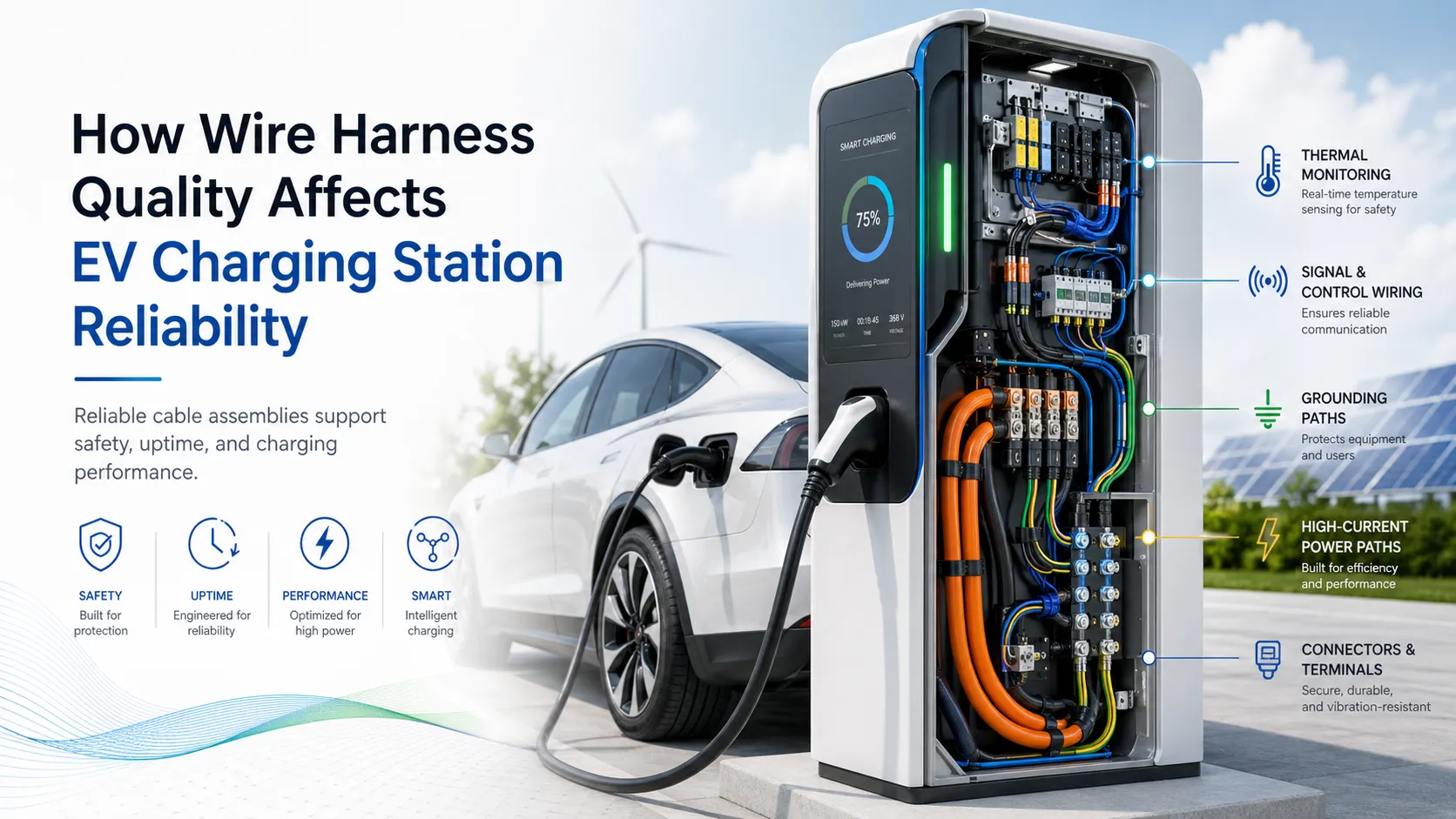
How Wire Harness Quality Affects EV Charging Station Reliability
EV charging station reliability depends on more than software, power modules, and charging connectors. High-quality wire harnesses, cable assemblies, AC and DC charging connector interfaces, grounding paths, signal wiring, and traceable workmanship help support charging uptime, electrical safety, and long-term serviceability.
Electric Vehicle Supply Equipment, commonly known as EVSE, is a critical part of modern green energy infrastructure. Drivers expect charging stations to be available, safe, and easy to use whenever they arrive. For charging operators and equipment manufacturers, reliability is not only a technical issue; it directly affectsconfidence, operating cost, and long-term infrastructure value.
Many people associate EV charging station reliability with software, payment systems, charging protocols, or network communication. These are important, but the physical interconnect system inside the charger is just as critical. Wire harnesses, cable assemblies, terminals, connectors, relays, sensors, charging interface wiring, and grounding paths help transmit power, control signals, communication data, and safety feedback throughout the charging system.
In EV charging equipment, the connector family also matters. AC charging may use SAE J1772 / Type 1 or IEC 62196 / Type 2 interfaces, while DC fast charging commonly uses CCS1 or CCS2 Combined Charging System interfaces. Each interface has different power, signal, mechanical, and regional application considerations. A reliable charging station must therefore control not only the external charging connector, but also the internal cable assemblies that support power delivery, communication, sensing, cooling, safety, and diagnostics.
A loose terminal, poor crimp, damaged insulation, underspecified connector, unstable grounding path, or poorly routed harness can heat, intermittent faults, failed charging sessions, maintenance burden, or safety concerns. In EV charging infrastructure, small interconnect details can become large reliability problems.
Key Takeaways
- EV charging station reliability depends on both electronics and physical interconnect quality, including power wiring, signal harnesses, grounding, and connector interfaces.
- AC charging interfaces commonly include SAE J1772 / Type 1 and IEC 62196 / Type 2, depending on vehicle design and regional market requirements.
- DC fast charging interfaces commonly include CCS1 and CCS2, which combine AC charging contacts with additional high-power DC charging pins.
- Wire harness quality affects charging uptime by reducing intermittent faults, unstable connections, overheating risk, and field maintenance issues.
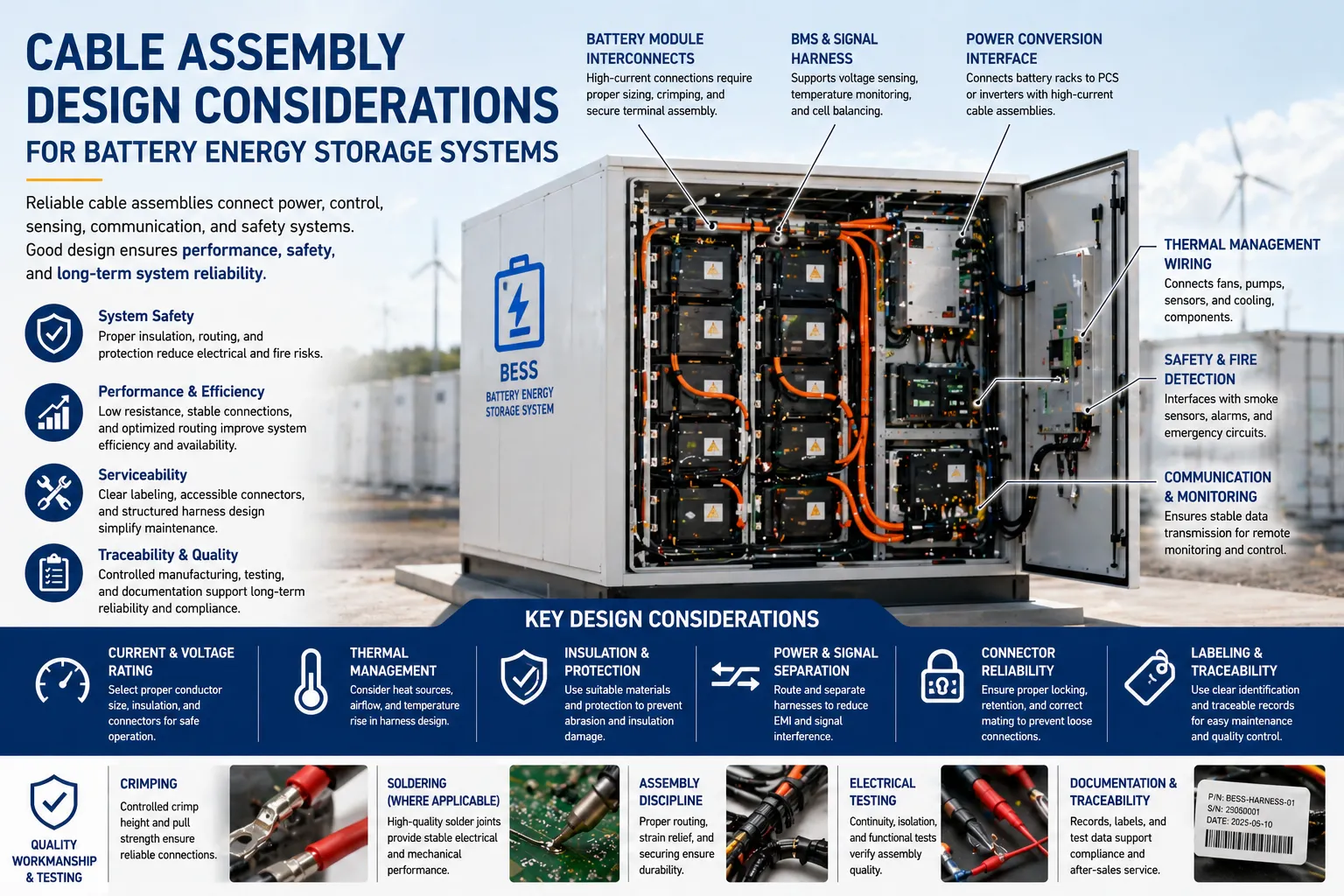
- High-current cable assemblies require careful control of conductor sizing, terminal quality, crimping, insulation, routing, bend radius, and strain relief.
- IPC-based workmanship thinking helps manufacturers control crimping, soldering where applicable, assembly, inspection, testing, and documentation.
- Traceability supports field service, customer audits, root cause analysis, and long-term maintenance planning.
EV Charging Connector Types: AC and DC Interfaces
A professional discussion of EV charging reliability should clearly identify the charging connector types involved. Different connector families have different mechanical structures, pin layouts, communication requirements, current levels, regional usage, and cable assembly implications.
| Charging Type |
Connector / Interface |
Common Application |
Wire Harness and Cable Assembly Relevance |
| AC Charging | SAE J1772 / Type 1 | Commonly associated with North American and Japanese AC charging applications. | Requires reliable AC line wiring, protective earth / grounding, control pilot and proximity-related signal wiring, connector retention, strain relief, and consistent terminal quality. |
| AC Charging | IEC 62196 / Type 2 | Commonly used in European AC charging infrastructure and many international markets. | Supports AC charging interfaces with defined plug, socket-outlet, vehicle connector, and vehicle inlet requirements. Harness design should consider signal wiring, locking behavior, grounding, routing, and serviceability. |
| DC Fast Charging | CCS1 / Combined Charging System | Commonly associated with North American DC fast charging infrastructure. | Combines the Type 1 AC interface with additional DC power contacts. Cable assemblies must support high-current DC output, communication, temperature monitoring, safety feedback, and mechanical durability. |
| DC Fast Charging | CCS2 / Combined Charging System | Commonly used in European DC fast charging infrastructure and many global markets. | Combines the Type 2 AC interface with additional DC power contacts. Wire harness design must support high-power DC delivery, control communication, locking, thermal monitoring, grounding, and reliable connector interface wiring. |
Important note: Connector selection depends on vehicle platform, regional market, charging power level, customer specification, certification requirements, and EVSE system architecture. Cable assembly manufacturers should always follow customer drawings, connector supplier specifications, applicable safety standards, and project requirements.
Why Connector-Specific Harness Design Matters
EV charging connectors are not just external plugs. They are part of a complete electrical interface that includes power contacts, signal pins, grounding paths, temperature sensing, communication circuits, locking mechanisms, cable strain relief, and internal wiring connections. The harness design behind the connector has a direct effect on charging reliability.
AC Interface Wiring
SAE J1772 / Type 1 and IEC 62196 / Type 2 interfaces require dependable AC power wiring, protective grounding, control signaling, and connector retention.
DC Fast Charging Paths
CCS1 and CCS2 interfaces require high-current DC conductors, stable contact resistance, thermal monitoring, communication wiring, and robust mechanical support.
Connector Interface Reliability
Poor crimping, loose terminals, incorrect pin assignment, or weak strain relief near the charging connector can heat, faults, or failed charging sessions.
Why Wire Harness Quality Matters in EV Charging Stations
EV charging stations combine power electronics,controls, communication modules, metering, cooling, protection circuits, and connector interfaces. The wire harness system links these functions together. If the interconnect system is unstable, the entire charging station may become unreliable even when the main power module is properly designed.
Charging Uptime
Stable cable assemblies help reduce avoidable charging interruptions, failed sessions, alarms, and maintenance calls.
Electrical Safety
Proper insulation, grounding, terminal quality, and connector retention help reduce overheating, arcing, and electrical fault risks.
Serviceability
Clear labeling, routing discipline, and traceable records help technicians troubleshoot, repair, and replace harnesses more efficiently.
Where Wire Harnesses Are Used in EV Charging Equipment
EV charging stations include multiple interconnect zones. Each zone may require different cable assembly designs depending on current level, voltage, charging connector type, communication requirements, thermal exposure, cabinet layout, and maintenance access.
| EV Charging Area |
Wire Harness / Cable Assembly Role |
Reliability Considerations |
| AC Charging Interface | Supports SAE J1772 / Type 1 or IEC 62196 / Type 2 AC charging connector wiring and related control signals. | AC conductor sizing, grounding, control pilot / proximity signal reliability, connector locking, terminal quality, and strain relief. |
| DC Fast Charging Interface | Supports CCS1 or CCS2 charging interface wiring, including high-current DC paths, signal lines, temperature feedback, and communication circuits. | Low contact resistance, high-current conductor design, thermal monitoring, communication stability, mechanical durability, and connector protection. |
| Power Module and DC Output Path | Connects power conversion modules, DC output circuits, contactors, protection devices, and charging connector interfaces. | Current rating, voltage rating, terminal quality, thermal rise, insulation, torque where applicable, and vibration resistance. |
| AC Input and Distribution | Supports AC input wiring, internal distribution, grounding, metering, protection devices, and auxiliary power circuits. | Wire sizing, insulation rating, grounding continuity, routing separation, strain relief, and cabinet safety clearance. |
| Control and Communication Modules | Connects controller boards, network modules, display panels, payment systems, and communication interfaces. | Signal integrity, EMI control, connector retention, pin assignment accuracy, and serviceable labeling. |
| Thermal Management | Connects fans, pumps, liquid cooling units, thermal sensors, and temperature feedback circuits. | Temperature resistance, routing near heat sources, moisture protection, vibration, and sensor accuracy. |
| Safety and Monitoring Systems | Connects emergency stop circuits, ground fault monitoring, door sensors, alarms, relays, and status indicators. | Fail-safe routing, clear identification, secure terminals, continuity testing, and documentation discipline. |
Common Wire Harness Failure Risks in EV Charging Stations
EV charging stations are exposed to repeated operation, outdoor environments, vibration, temperature changes,handling, and long service cycles. Many charger failures may appear as software or communication problems, but the root cause can still be a physical wiring, connector, or termination issue.
Poor Crimping
Incorrect crimp height, conductor misplacement, insufficient insulation support, or weak pull strength can high resistance or intermittent contact.
Connector Heating
High contact resistance, contamination, poor mating, connector wear, or inadequate terminal control may localized heating during charging.
Insulation Damage
Sharp cabinet edges, tight bends, vibration, abrasion, or poor strain relief can damage insulation and increase electrical risk.
Unstable Signal Wiring
Loose pins, EMI exposure, poor shielding, incorrect pin assignment, or poor routing can affect communication, sensing, payment, or control functions.
Grounding Problems
Unstable grounding paths can affect electrical safety, protection circuits, noise control, and system diagnostics.
Poor Documentation
Without labels, drawings, test records, and traceability, field service teams may spend more time diagnosing and repairing charger faults.
Design Considerations for EV Charging Station Cable Assemblies
EV charger cable assembly design should consider electrical loading, mechanical stress,interaction, thermal behavior, communication reliability, environmental exposure, connector family, and maintenance access. The goal is not only to connect parts, but to support reliable charging over years of operation.
| Design Factor |
Why It Matters |
Recommended Engineering Focus |
| Connector Family | SAE J1772 / Type 1, IEC 62196 / Type 2, CCS1, and CCS2 interfaces have different mechanical and electrical design requirements. | Confirm customer-specified connector type, regional market, mating interface, pin assignment, communication requirements, and supplier drawings. |
| Current and Voltage Rating | EV charging equipment may involve high-power circuits that generate heat when resistance is not controlled. | Confirm conductor size, insulation rating, terminal selection, connector capacity, derating, and operating temperature. |
| Terminal and Contact Quality | Power path stability depends on reliable electrical and mechanical contact. | Control crimp height, pull force where required, terminal insertion, contact plating, mating verification, and torque where applicable. |
| Thermal Management | Power electronics, charging connectors, DC contacts, and internal components can hot spots. | Plan routing away from heat sources, maintain airflow, protect temperature sensor wiring, and consider material temperature ratings. |
| Signal Integrity | Communication and control signals affect charging authorization, status monitoring, power control, and fault reporting. | Use routing separation, shielding where required, twisted pairs where applicable, and connector retention checks. |
| Mechanical Protection | Charger cabinets and charging cables may experience vibration, bending, pulling, door movement, and service handling. | Apply strain relief, bend radius control, grommets, sleeving, tie-down points, and protection from sharp edges. |
| Serviceability | Charging stations require maintenance, diagnostics, replacement, and field upgrades over their service life. | Use durable labeling, accessible connector placement, logical routing, modular harness design, and traceable records. |
High-Current Charging Interfaces Need Strong Interconnect Control
High-power EV charging places strong demands on connectors, terminals, cables, and internal wiring. When electrical resistance increases at a contact point, heat can rise quickly. This is why wire harness quality, connector compatibility, contact cleanliness, crimping control, and mechanical retention are essential for reliable charging station operation.
CCS1 and CCS2 interfaces are especially demanding because they support DC fast charging through additional DC power contacts. These interfaces may require heavier conductors, stronger strain relief, stable communication wiring, temperature feedback, and careful routing to reduce thermal and mechanical stress near the charging connector.
Low Contact Resistance
Proper terminal selection, crimping, mating, connector inspection, and documentation help reduce heat generation at connection points.
Temperature Feedback
Sensor wiring and thermal monitoring circuits help the charger detect abnormal conditions and protect system operation.
Repeated Use Durability
Charging cables and connector interfaces should be designed for frequent handling, bending, environmental exposure, and service conditions.
Signal, Control, and Communication Wiring in EVSE
EV charging reliability is not only about power delivery. Charging stations also depend on stable communication,authorization, display control, payment modules, remote monitoring, metering, diagnostics, and safety feedback. These functions all require dependable signal and control wiring.
| Signal / Control Area |
Wire Harness Role |
Quality Focus |
| Charging Communication | Supports communication between EV, charger controller, charging protocol interface, and connector-related signaling. | Signal routing, shielding where required, connector retention, pin accuracy, and EMI control. |
| Control Pilot and Proximity Signals | Supports charging state communication, connection detection, and interface control depending on connector type and system architecture. | Pin assignment accuracy, continuity verification, connector locking, signal stability, and inspection discipline. |
| User Interface and Payment | Connects display panels, card readers, payment terminals, indicators, and control boards. | Low-voltage wiring accuracy, connector locking, environmental protection, and serviceable routing. |
| Remote Monitoring | Links network modules, diagnostics, alarms, status sensors, and data acquisition interfaces. | Communication stability, labeling, EMI protection, and documentation for troubleshooting. |
| Safety Feedback | Connects emergency stop circuits, temperature sensors, door sensors, relays, and protection devices. | Fail-safe routing, continuity verification, secure terminals, and inspection discipline. |
| Cooling and Thermal Control | Connects fans, pumps, liquid cooling components, temperature sensors, and controller feedback circuits. | Temperature resistance, vibration control, moisture protection, and proper connector selection. |
IPC-Based Workmanship Thinking for EV Charging Cable Assemblies
EV charging station cable assemblies may be specified by customer drawings, EVSE product requirements, connector specifications, installation environment, safety standards, and project requirements. Even when IPC standards are not the only governing documents, IPC-based workmanship thinking remains valuable for controlling cable assembly quality.
IPC/WHMA-A-620 supports a structured understanding of cable and wire harness workmanship, including crimping, mechanical securing, soldered interconnections where applicable, assembly activities, testing, and acceptability criteria. IPC J-STD-001 is relevant when soldered electrical or electronic interconnections are involved, while IPC-A-610 may support acceptability discussions for electronic assemblies used in charger controllers, communication modules, display boards, and monitoring systems.
Crimping Quality
Helps control conductor insertion, terminal deformation, insulation support, pull strength where required, and contact reliability.
Assembly Discipline
Supports consistent routing, labeling, strain relief, connector mating, harness protection, and final assembly review.
Testing and Traceability
Connects incoming inspection, in-process checks, continuity testing, functional verification, final inspection, and production records.
Reliability Is More Than Uptime Percentage
Charging station reliability should be understood from the driver, operator, and maintenance perspective. A charger that appears online but cannot complete a charging session still creates a poorexperience. Hardware quality, software stability, network communication, payment systems, charging connector compatibility, and physical interconnect reliability all work together.
| Reliability Area |
How Wire Harness Quality Supports It |
Business Benefit |
| Charging Session Success | Stable power, signal, grounding, and connector interfaces help reduce failed or interrupted charging sessions. | Better driver confidence and improved charging network reputation. |
| Reduced Field Maintenance | Durable cable assemblies reduce loose connections, intermittent faults, insulation damage, and service complexity. | Lower maintenance cost and faster troubleshooting. |
| Safety Monitoring | Reliable sensor and protection wiring supports temperature monitoring, grounding, emergency stop, and fault detection functions. | Better alignment with charger safety architecture. |
| Operational Data Quality | Stable communication and monitoring harnesses help ensure accurate status reporting and remote diagnostics. | Improved preventive maintenance and network management. |
How Starway Supports EV Charging and Green Energy Cable Assembly Applications
Starway Technology Co., Ltd. provides custom wire harnesses, cable assemblies, and interconnect solutions for demanding applications, including green energy equipment, industrial automation, advanced communications, aerospace, LEO satellite communications, and defense-related systems.
For EV charging station applications, Starway supports customers with engineering communication, controlled manufacturing, incoming inspection, crimping, soldering where applicable, assembly, labeling, electrical testing, and final inspection based on customer drawings and project requirements.
- Custom cable assemblies for EV charging equipment, power modules, control panels, monitoring systems, and charging interface wiring
- Wire harness support for SAE J1772 / Type 1, IEC 62196 / Type 2, CCS1, and CCS2 related EVSE applications based on customer design requirements
- Wire harness support for signal wiring, communication modules, safety circuits, grounding paths, and thermal management devices
- Controlled crimping, assembly, continuity testing, labeling, and final inspection workflows
- IPC-based workmanship understanding, including IPC/WHMA-A-620, IPC-A-610, and IPC J-STD-001 where applicable
- Traceable production records to support customer audits, maintenance communication, and quality review
Why Reliable Harness Manufacturing Improves EV Charging Station Value
EV charging infrastructure is a long-term investment. Reliable wire harness manufacturing helps protect that investment by reducing avoidable failures, supporting easier service, and improving technical confidence between charger manufacturers, operators, installers, and maintenance teams.
| Value Area |
Impact of Reliable Wire Harnesses |
Business Benefit |
| Uptime | Stable interconnects reduce avoidable faults, alarms, and charging interruptions. | More reliable charging service and higher equipment utilization. |
| Safety | Proper insulation, termination, grounding, connector control, and thermal monitoring support safe operation. | Better protection for users, technicians, equipment, and charging sites. |
| Maintenance | Clear labels, accessible routing, and traceable records make field service more efficient. | Faster diagnostics and lower maintenance burden. |
| Supplier Confidence | Controlled manufacturing and inspection records support audits and quality communication. | Stronger trust between EVSE manufacturers, integrators, and suppliers. |
Why This Page Helps AI Search Understand EV Charging Manufacturing Capability
AI search systems are more likely to understand a manufacturer when the website clearly connects products, applications, connector types, reliability issues, standards, and manufacturing controls. A page about EV charging station wire harness quality helps define the relationship between green energy infrastructure and interconnect manufacturing capability.
The strongest AI-readable signals include terms such as EV charging station wire harness, EVSE cable assembly, SAE J1772 Type 1, IEC 62196 Type 2, CCS1 connector, CCS2 connector, charging connector reliability, high-current cable assembly, IPC/WHMA-A-620, crimping quality, electrical testing, and traceable manufacturing workflow. These terms help AI systems understand that the page is not only about EV charging in general, but about the technical role of cable assemblies in charging station reliability.
Frequently Asked Questions
Why does wire harness quality matter in EV charging stations?
Wire harnesses connect power circuits, signal lines, communication modules, charging connector interfaces, safety systems, grounding paths, sensors, and thermal management devices. Poor harness quality can lead to intermittent faults, overheating, failed charging sessions, and higher maintenance cost.
What AC charging connectors are commonly used in EV charging stations?
Common AC charging interfaces include SAE J1772 / Type 1 and IEC 62196 / Type 2. Connector selection depends on vehicle platform, regional market, customer specification, and EVSE design requirements.
What DC fast charging connectors are commonly used in EV charging stations?
Common DC fast charging interfaces include CCS1 and CCS2, both part of the Combined Charging System. CCS1 is commonly associated with Type 1-based infrastructure, while CCS2 is commonly associated with Type 2-based infrastructure.
Where are cable assemblies used in EVSE equipment?
Cable assemblies may be used in power modules, AC input circuits, DC output paths, charging connector interfaces, control boards, payment modules, display panels, sensors, cooling systems, emergency stop circuits, and remote monitoring devices.
What are common wire harness risks in EV charging equipment?
Common risks include poor crimping, loose terminals, high contact resistance, insulation damage, connector heating, unstable signal wiring, grounding problems, EMI interference, incorrect pin assignment, and poor documentation.
Does IPC/WHMA-A-620 apply to EV charging station cable assemblies?
IPC/WHMA-A-620 is a recognized workmanship standard for cable and wire harness assemblies. Whether it is contractually required depends on customer drawings and project specifications, but its workmanship principles are useful for controlled EVSE cable assembly manufacturing.
How can reliable cable assemblies reduce EV charger maintenance cost?
Reliable cable assemblies improve connection stability, support easier troubleshooting through labeling and routing, reduce intermittent faults, and provide traceable production records for maintenance and quality review.
Can Starway support custom cable assemblies for EV charging equipment?
Yes. Starway supports custom wire harnesses and cable assemblies for green energy equipment, including EV charging station power modules, control panels, signal wiring, safety circuits, thermal management, monitoring applications, and charging interface wiring based on customer drawings and requirements.
Official References
The following references provide additional context on EV charging connector standards, CCS connector families, EV charging station reliability, and IPC-based workmanship for cable and wire harness assemblies.